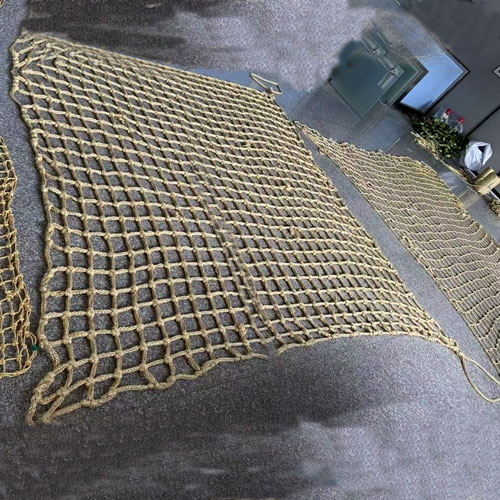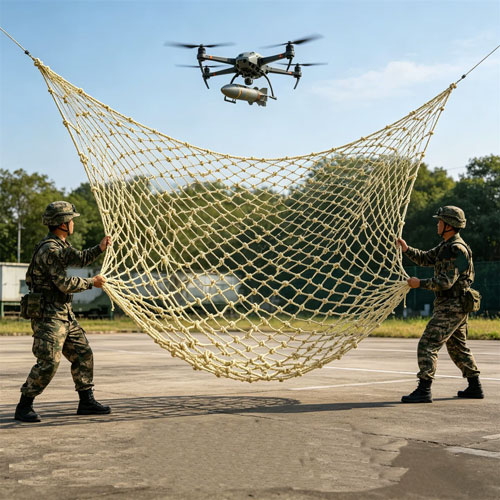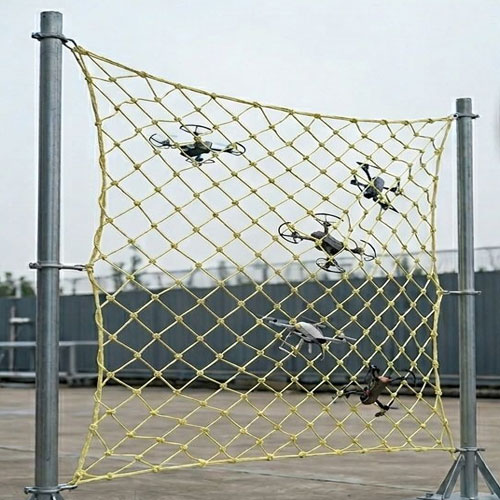
Aramid Knotted Anti Drone Net: Ultra-High Tensile UAV Perimeter Defense Barrier
Military-grade continuous-filament Para-Aramid (Kevlar®) barrier system. Engineered with mechanically locked knots to eliminate shear failure, providing certified 70.67 kN breaking capacity and unmatched energy absorption for critical airspace protection.
Key Engineering Takeaway: Why Knotted Aramid Outperforms Steel Wire & Knotless Netting
Para-Aramid fiber possesses ultra-high tensile modulus with near-zero elongation (<2.5%). under="" high-speed="" uav="" kinetic="" impact="">Aramid knotted Anti Drone net utilizes locked mechanical knots that isolate stress points, delivering 70.67 kN (7.07 Tons) tensile resistance in 10mm specification—surpassing cold-pressed aluminum-ferruled stainless steel wire mesh by over 81% while slashing deadload weight by 78.9%.
1. The Physics of Drone Interception: Knotted Integrity vs. Knotless Shear Degradation
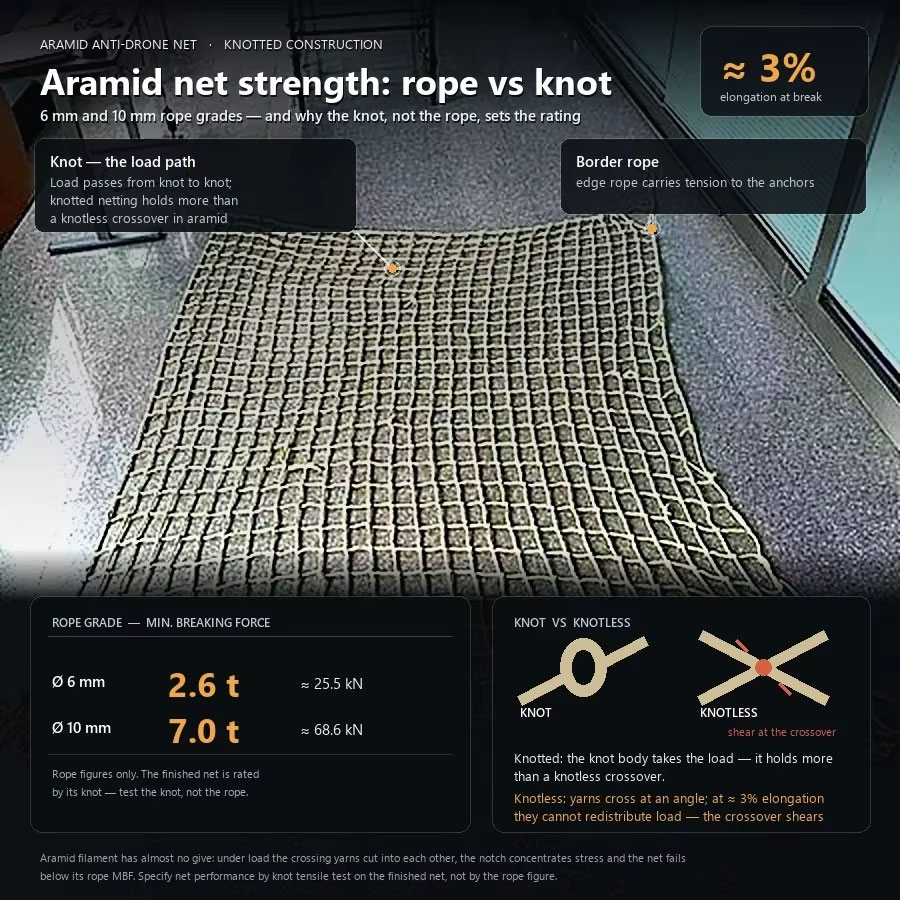
Modern commercial and tactical FPV drones carry significant kinetic mass at speeds exceeding 120 km/h. Stopping these aerial threats requires instantaneous energy dissipation without structural compromise. While Para-Aramid (Kevlar®) is the premier synthetic fiber for ballistic and impact protection, its structural fabrication geometry dictates field survivability:
❌ Knotless Aramid Weave (Catastrophic Shear)
In knotless raschel knitting, unanchored crossing filaments slide across one another during impact. Because aramid molecules have rigid crystalline alignment, the abrasive sliding generates intense transverse friction—literally cutting adjacent fibers and reducing overall net strength by 60% to 75%.
✓ Locked Knotted Construction (Zero Shear Loss)
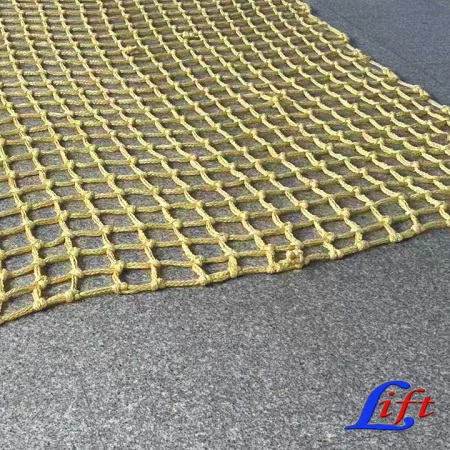
Our mechanically locked knots isolate each mesh aperture into an independent stress cell. Impact load is routed purely along the rope's longitudinal axis without inter-filament slippage, preserving 100% of the raw aramid tensile strength and wrapping drone propellers upon impact.
2. Aramid Knotted Anti Drone Net Specifications
Manufactured strictly from virgin high-tenacity continuous filament Para-Aramid, available in tailored aperture pitches for specialized defense requirements:
| Rope Dia. (mm) | Braid Construction | Mesh Pitch (mm) | Breaking Force (kN / Ton) | Energy Capacity (J) | Areal Weight (g/m²) |
|---|---|---|---|---|---|
| 4.0 mm | 16-Plait Braided Knotted | 50x50 – 100x100 | 12.5 kN (1.28 T) | 4,800 J | ≈ 280 |
| 6.0 mm | 24-Plait Braided Knotted | 80x80 – 150x150 | 25.5 kN (2.60 T) | 12,500 J | ≈ 460 |
| 8.0 mm | 32-Plait Braided Knotted | 100x100 – 200x200 | 45.0 kN (4.59 T) | 24,000 J | ≈ 780 |
| 10.0 mm (Certified) | Multi-Strand Core Braid | 100x100 – 250x250 | 70.67 kN (7.07 T) | 48,500 J | ≈ 1,180 |
| 12.0 mm | Heavy Core-Braid Knotted | 150x150 – 300x300 | 98.2 kN (10.01 T) | 72,000 J | ≈ 1,650 |
* Certified Test Data: Specimen Dia10mm verified by TaiZhou Lift Sling Net Belt Factory Tensile Testing Laboratory (Report No. 26101406, Maximum Force Fm = 70.67 kN).
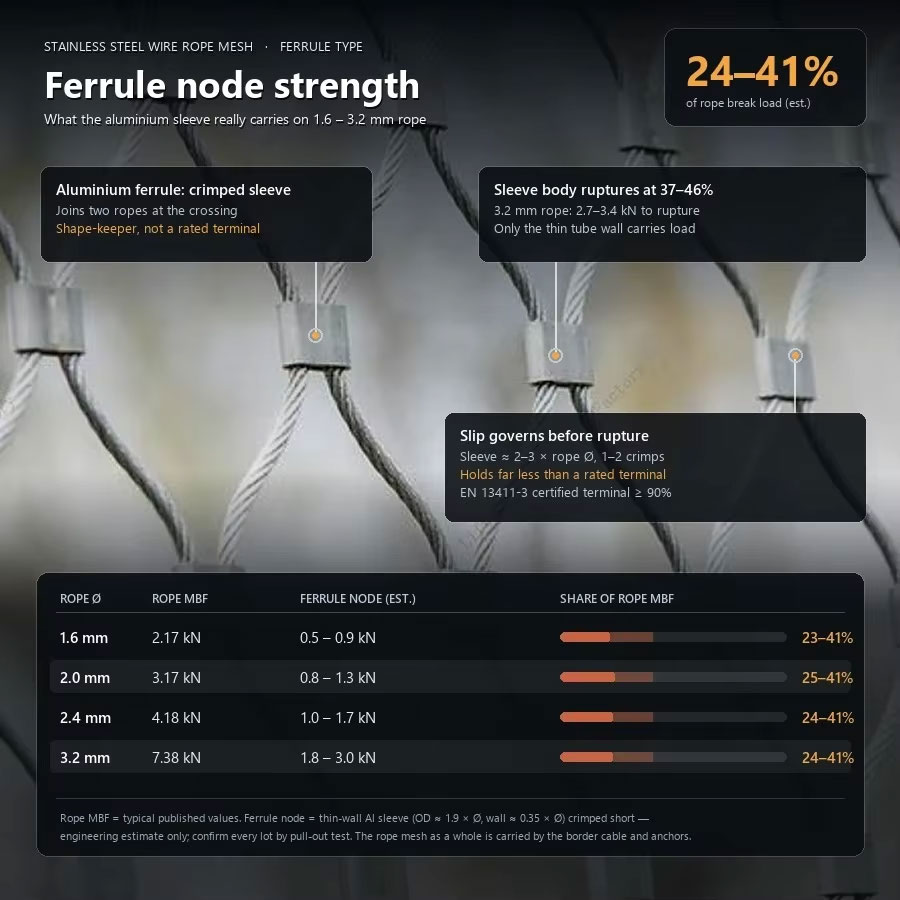
3. Engineering Bottleneck: Ferruled Steel Wire Mesh vs. Knotted Aramid
Conventional stainless steel wire mesh relies on cold-pressed aluminum sleeves (DIN EN 13411-3). Under dynamic impact, the aluminum ferrule experiences severe shear stress and slips, creating a massive weak point where joint breaking strength is far lower than the wire rope itself:
| Wire/Rope Size | Steel Wire Breaking Load | Aluminum Ferrule Limit (DIN EN 13411-3) | Aramid Knotted Net Breaking Load | Strength Differential |
|---|---|---|---|---|
| 3.0 mm | 500 kg (0.50 T) | 5.4 kN (552 kg) | 8.5 kN (0.87 T) | +57.6% over Sleeve |
| 4.0 mm | 900 kg (0.90 T) | 9.6 kN (981 kg) | 12.5 kN (1.28 T) | +30.5% over Sleeve |
| 6.0 mm | 2,000 kg (2.00 T) | 1.40 Ton (Failure Bottleneck) | 2.60 Ton (25.5 kN) | +85.7% Strength Advantage |
| 10.0 mm | 5,200 kg (5.20 T) | 3.90 Ton (Failure Bottleneck) | 7.07 Ton (70.67 kN) | +81.2% Strength Advantage |
4. Tactical Advantages in Perimeter & Critical Asset Defense
78.9% Deadweight Reduction: Weighing only ~1.18 kg/m² compared to over 5.6 kg/m² for equivalent steel mesh, allowing installation on lightweight masts, catenary cables, and rapid-deployment field frames without heavy foundations.
Zero Radar & RF Interference: Aramid is 100% non-conductive and dielectric. Unlike steel wire mesh which reflects and distorts RF frequencies, our nets do not degrade early-warning radar arrays, communication antennas, or electronic warfare jammers.
Inherently Flame Retardant & Weatherproof: Limiting Oxygen Index (LOI) > 28%, self-extinguishing with zero melting point (degrades only at >450°C). Immune to marine salt fog, industrial acid gases, and galvanic corrosion.
Cross-Category Versatility: Seamlessly integrate with our high-durability safety rope net arrays, or combine with our heavy-duty Para Aramid Safety Net and Knotted Anti Drone Net solutions.
5. Frequently Asked Questions (FAQ)
Q1: Can high-speed carbon fiber propellers slice through the Aramid net?
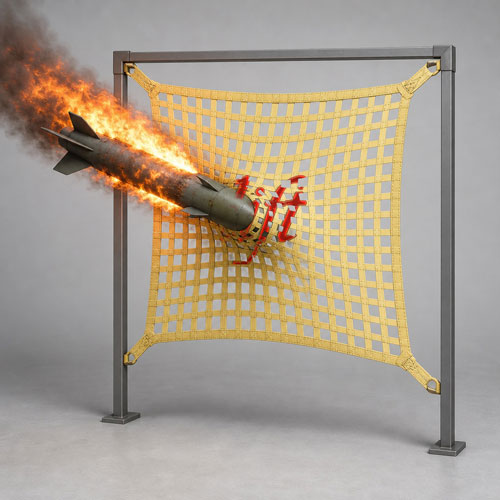
No. Para-Aramid possesses exceptional cut and abrasion resistance. High-RPM carbon fiber or polymer rotors cannot slice through the braided aramid core; instead, the flexible net wraps tightly around the rotor shafts, instantly locking the motors and capturing the UAV intact.
Q2: What mesh aperture size is recommended for drone interception?
For commercial quadcopters and mini-UAVs (e.g., DJI Mavic/Matrice series), a 50x50 mm to 100x100 mm aperture is recommended. For larger tactical FPV drones or fixed-wing loitering munitions, 100x100 mm to 200x200 mm aperture with 8mm to 10mm rope diameter provides optimal kinetic stopping power.
Q3: How is the net anchored to perimeter support structures?
We supply high-strength aramid perimeter boundary ropes fitted with stainless steel thimbles and high-tenacity tensioning lanyards, allowing rapid installation onto steel poles, building parapets, catenary wire systems, or mobile rapid-deployment trailers.