High Strength Anti drone net
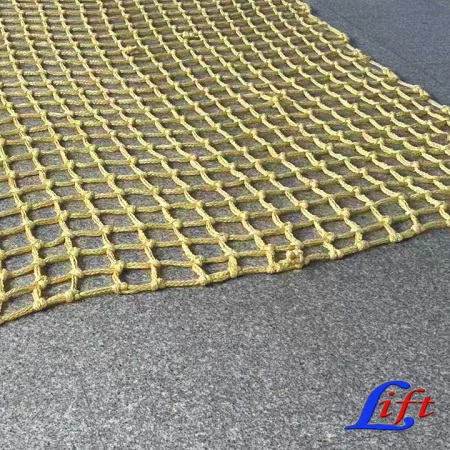
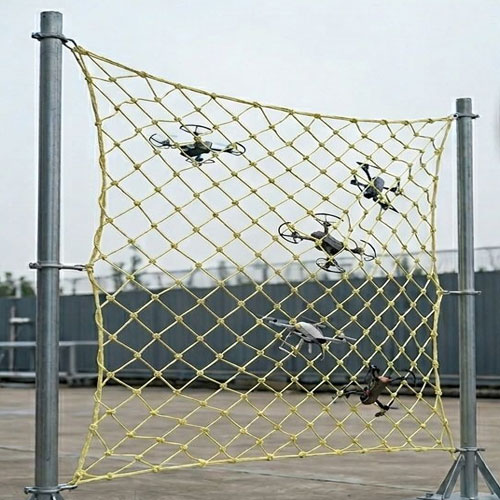
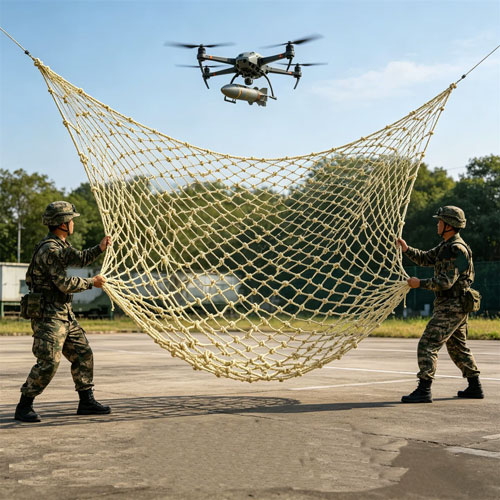
A high strength anti drone net is a passive interception barrier: a mesh of high-strength Kevlar webbing or braided aramid rope, hung across the line a small unmanned aircraft would fly through, with an aperture smaller than the part of the aircraft that would arrive first and a joint strong enough to take the impact without opening. It is light enough to be handled by two people, it does not burn through, and it asks for no power, no radar and no operator to be in the right place at the right moment. China Lifute Sling Group weaves the aramid, braids the rope and knots the panel in one works in Taizhou, Jiangsu.
The figure that separates a barrier from a gesture is not the strength of the rope on the reel. It is the strength of the joint where one rope hands its load to the next. A 10 mm aramid rope breaks at 7 t on a single-strand straight pull; knotted and braided into a net, the same rope gives roughly four times the joint strength of a clamped panel, because four rope ends meet in every knot and share the load before it ever reaches the border. On a wire rope net pressed together with aluminium ferrules, each pressed joint holds 200kg-300 kg — and a panel repeats that joint across every mesh in the opening.
FibrePara-aramid (Kevlar-type)
FormWebbing 25–50 mm / rope 6–12 mm
Rope break, 6 mm2.6 t straight pull
Rope break, 10 mm7 t straight pull
JointKnotted — about 4×
Mesh40–120 mm
Panelto 10 × 20 m
Weight≈ 1.6 kg/m²
Where an anti drone net actually fails
A drone arriving at a barrier brings mass multiplied by velocity, and the net has one short distance of sag in which to take that energy away. A 0.9 kg quadcopter at 20 m/s carries about 18 kg·m/s of momentum and 180 J of energy — a small number until it has to be absorbed in the 100 mm a taut panel will give. The aircraft either stops in the mesh, or it converts one mesh into a hole and carries on to whatever the net was protecting.
Five things decide which of those happens, and only the first is about the fibre:
The aperture — has to be smaller than the part that would pass first, which on a multirotor is the propeller disc and on a fixed wing is the leading edge.
The joint — where the load leaves one rope and enters the next. On most netting this is the weakest element by a wide margin, and on this page it is the whole subject.
The border — which collects everything the mesh gathers and carries it to the anchors. It is spliced, never knotted, because a knot in the border would put the entire panel through one joint at its most heavily loaded point.
The anchors — a panel that is strong enough and tied to 2 m posts will fail at the posts, not at the mesh.
The stand-off — clear space behind the panel for a caught aircraft to deform into, instead of reaching the asset it was aimed at.
That is why a drone net of this class is quoted against an opening and an aircraft rather than against one blanket capacity number, and why a net sold on the strength of its rope alone is being sold on the figure that rarely governs. The full range of panels, meshes and edge details sits in our safety rope nets category; the selection logic is set out in how to choose a drone anti-collision net.
The rope: 2.6 t at 6 mm, 7 t at 10 mm
Everything on this page is sized from the rope, so start there. Our standard aramid braid is a 12-strand construction with no core. A 6 mm rope breaks at 2.6 t on a single-strand straight pull; a 10 mm rope breaks at 7 t under the same test. Both figures are rope values measured on our own horizontal test bed, and every consignment is tested, so the batch certificate — not this page — is the number to design from.
| Rope Ø | Break, single-strand straight pull | Where it is used |
|---|---|---|
| 6 mm | 2.6 t | Fine mesh over small multirotors, window and vent screens, low-wind-area panels |
| 10 mm | 7 t | Perimeter and rooftop interception, the standard build for a real kinetic impact |
| 4 / 8 / 12 mm | Braided to order, tested per batch | Lighter screens, or heavier panels where the opening and the wind load ask for it |
Break load is quoted per rope, not per panel. A panel is loaded per metre of width, and that figure is set by the mesh as much as by the rope — halve the mesh and you double the number of legs carrying load across the same width.
What the figure does not tell you is how the rope behaves on its way to breaking. Aramid elongates about 3.5 % before it fails and under 1.5 % at working load, so an impact is transferred to the joint, the border and the anchors almost as quickly as it arrives at the panel. There is no long elastic stretch buying time; what buys the margin instead is the number of load paths. For the same reason aramid is roughly five times the strength of steel wire at equal weight, which is what lets a 10 × 20 m panel stay light enough to be handled on site.
How the aramid is braided
The rope is not commodity line bought in and knotted here. Aramid fibre is braided on our own machines to a process developed for this net: the strands are interwoven rather than twisted, so the rope stays round under load instead of flattening into an oval, it cannot unlay if a strand is cut, and — the part that matters for interception — it keeps its strength as it turns through the curvature of a knot. A twisted rope loses more in the knot, because its lay opens under load and the strands do not share the bend.
Rope construction:
12-strand braid, no core — no straight core filaments to take load unevenly, and no core to migrate when the rope is bent.
UV-stabilised aramid — aramid is more UV-sensitive than polyester, so the fibre is specified for outdoor service and can be PU or neoprene dipped where the panel faces sun and abrasion.
No melting point in service — the rope carbonises from about 400 °C and holds its geometry, so a drone arriving on fire lands in a panel that does not become fuel and does not drip onto the roof below.
Any diameter in the family — 4 to 12 mm as standard, heavier braids to drawing; the same rope is supplied on its own as nylon and aramid rope for lashings and heat-exposed lines.
From rope to net: why the knot is worth four times the strength
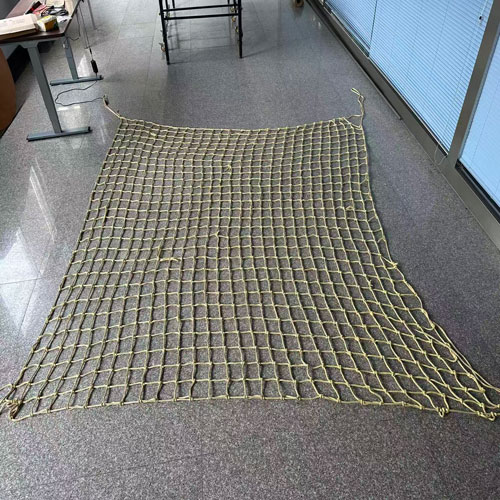
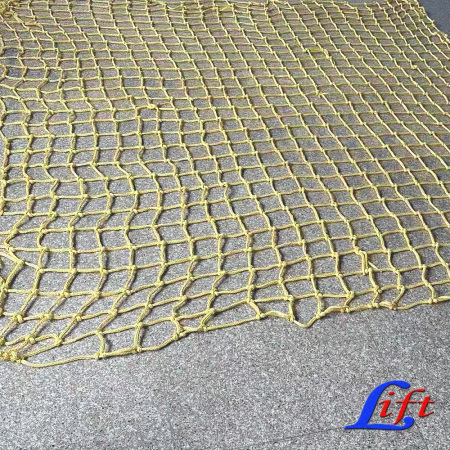
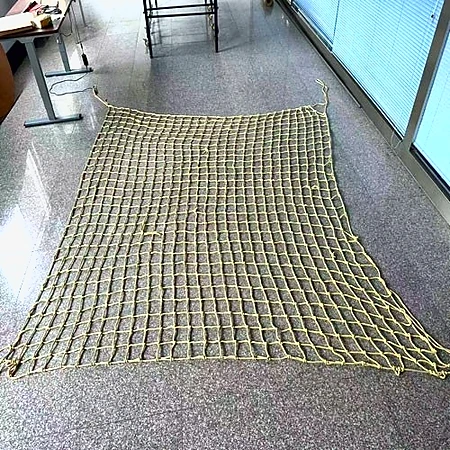
Count the rope ends going into a single knot on the panel: four. Each mesh leg terminates in a knot that wraps around its own turns, so load entering from one direction passes through the curvature of the knot and leaves through the other three legs. It never travels through rope sliding on rope, and it is never gripped by a device that can slip. A knotted aramid rope net is therefore specified at about four times the joint strength of the same rope held in a clamp, on a fraction of the weight.
The multiplier is not a marketing factor, it is the arithmetic of the joint: a clamp holds one rope end; a knot holds four and lets them share. It also decides how the net fails. A knotted panel degrades — one mesh takes the damage, the surrounding meshes hold, and the panel can be re-knotted and put back into service. A clamped or knotless panel tends to unzip from the point of impact along the line of least resistance, and the failure is progressive and unpredictable. This is the design argument for the high strength aramid drone defense rope net, and the reason the same knotting is used across our drone anti-collision net range.
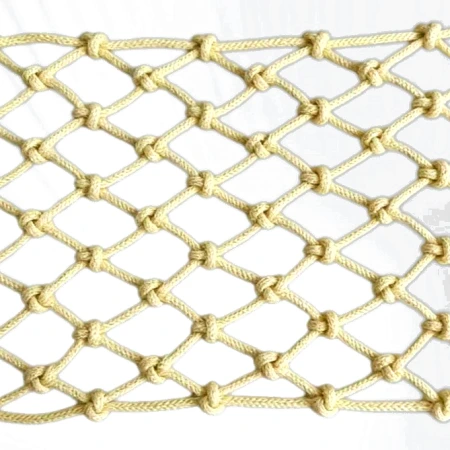
The twenty-tonne class panel
Put the two numbers together and the panel stops being a fence and starts behaving like a drone interception net rather than a screen. A 10 mm rope breaks at 7 t, and the knot delivers about four times the joint strength of the same rope clamped — so a single knot in a 10 mm panel is calculated at roughly 28 t. In a 100 mm mesh there are ten legs crossing every metre of width, in both directions; the calculated capacity of the finished panel therefore sits well into the twenty-plus tonne class, and a 50 mm mesh doubles the number of legs and takes the figure higher again. That is the order of strength a knotted aramid net reaches where a wire rope net with aluminium ferrules tops out at 200–300 kg per joint.
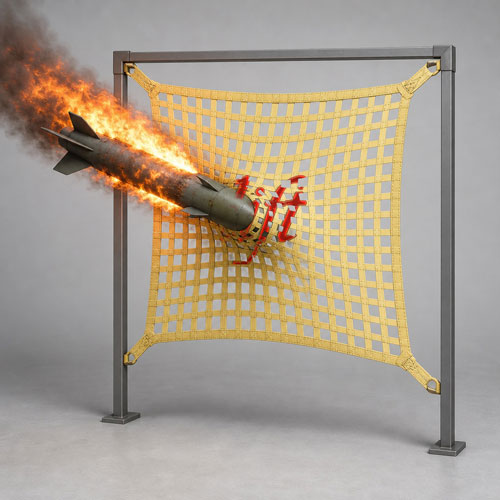
At this level the panel also changes category. A 20 t-plus knotted aramid barrier is in the class of structure that can be engineered against a loitering munition or a missile seeker rather than against a hobby quadcopter: the impact energy of a fast, heavy body is arrested in the panel instead of passing through it, and the knots spread a local hit over an area several meshes wide rather than concentrating it at one crossover.
What we will and will not claim. The twenty-tonne figure is engineering arithmetic on the rope and knot values above, and it is the number we design from — it is not a certificate for any particular threat. Whether a given projectile is stopped depends on the panel geometry, the mesh, the stand-off and the anchors, so every defence or military enquiry is quoted and, where required, proof-tested per project rather than published as a blanket capacity. Send the threat and we will answer it with a test, not an adjective.
Two builds: Kevlar webbing and aramid rope
The net is made in two forms, and they are not interchangeable. The choice is made by the threat, not by the price per square metre.
| Kevlar aramid webbing | Knotted aramid rope | |
|---|---|---|
| Form | 25–50 mm flat webbing stitched or laced into a grid | 12-strand braided aramid rope, double-knotted into mesh |
| Strength at the joint | Set by the stitching and by the webbing it is made from | 2.6 t on 6 mm, 7 t on 10 mm; about 4× a clamped joint |
| Elongation | Low, and the flat section spreads a glancing hit | About 3.5 % at break; load reaches the joint almost undamped |
| Fire behaviour | Does not melt; carbonises and holds shape | Does not melt; carbonises and holds shape |
| Weight | Light per square metre, economical on large screens | About 1.6 kg/m² at 100 mm mesh in 10 mm — light for its strength, still a two-person panel at 10 × 20 m |
| Where it fits | Perimeter and site screening, slow and light aircraft, contraband flights, temporary installations | Real kinetic impact, high-value assets, radiant heat, permanent installations, defence work |
Where the fire case rather than the impact case governs, the flat-belt version is specified as a fireproof aramid flat belt safety net for missile and drone interception, which is built around the same fibre and the same non-melting behaviour.
Specifications
| Item | Specification |
|---|---|
| Fibre | Para-aramid (Kevlar / Technora class), UV-stabilised |
| Form | Webbing 25 / 38 / 50 mm; braided rope 6 / 8 / 10 / 12 mm (4 mm to order) |
| Rope construction | 12-strand braid, no core |
| Break load, single rope | 6 mm ≈ 2.6 t; 10 mm ≈ 7 t — batch certificate governs |
| Elongation | ≈ 3.5 % at break; under 1.5 % at working load |
| Joint | Double knot, four rope ends per knot, set by hand and locked; about 4× a clamped joint |
| Mesh (knot pitch) | 40 / 50 / 60 / 80 / 100 / 120 mm, square or diamond |
| Panel size | 5 × 10 m, 10 × 10 m, 10 × 20 m; larger openings as joined panels |
| Border | Same braid or one size up, double-laid and spliced — not knotted |
| Fixing points | Corner eyes, stainless thimbles, eyelets or D-rings at your anchor spacing |
| Weight | ≈ 1.6 kg/m² for 10 mm braid at 100 mm mesh |
| Thermal | No melting point in service; continuous to about 200 °C, carbonises from about 400 °C |
| Colour | Natural aramid gold, black, or to order |
| Coating | Uncoated, or PU / neoprene dipped for UV and abrasion on permanent outdoor panels |
| Marking | Tag with panel size, rope Ø, mesh, fibre and batch number |
| HS code | 630790 (indicative — confirm with your broker) |
| Origin | China Lifute Sling Group — Taizhou, Jiangsu, China |
Rope diameter, mesh and weight are manufacturing ranges, not a performance guarantee. The strength of the installed barrier belongs to the whole assembly — panel, knot, border, anchors and stand-off — and is confirmed on the approval drawing.
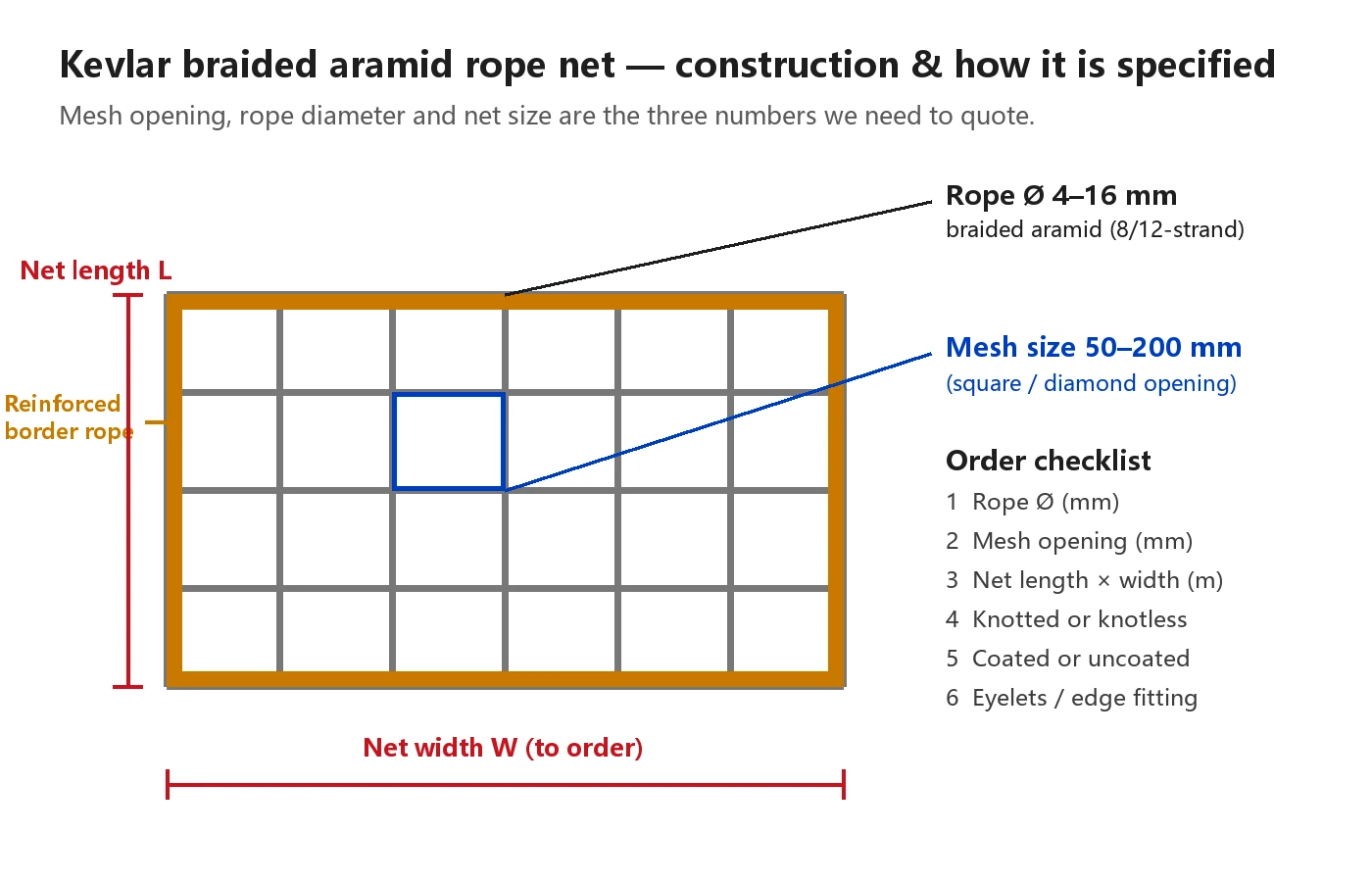
Mesh size: match the aperture to the aircraft
Aperture is the first thing buyers ask for and the number most often quoted without saying what it has to retain. Work from the aircraft: the opening has to be small enough that the part which arrives first cannot pass through it.
| What must be retained | Aperture | Why that opening |
|---|---|---|
| Propeller disc, small multirotor | 40–60 mm | A blade cannot pass; an arm enters and the airframe is caught at the crossing |
| Airframe, larger multirotor and fixed wing | 80–100 mm | Props and arms are caught, the body is stopped by the panel behind them |
| Weight and wind critical | 120 mm | The open option, where panel weight and wind area matter more than aperture |
| Payload, tools and debris below the flight path | 25–40 mm | Secondary containment, emptied at inspection |
Aperture is quoted between rope centres unless a clear opening is specified; the two figures differ by one rope diameter.
Fire and heat: the drone that arrives burning
Interception has a second hazard that a strength table does not show. A multirotor that has been hit, has failed a battery, or is carrying an incendiary payload arrives on fire, and it arrives into whatever the barrier is made of. Polyester, polypropylene and nylon nets soften or melt under sustained heat and can turn a caught drone into burning material dripping onto the asset below. Aramid has no melting point in service: it carbonises from about 400 °C and keeps its geometry, so the panel keeps holding the airframe while it burns. The flame behaviour behind this build is set out in why choose a flame-retardant aramid fiber safety net.
Where it is specified
Airports, helipads and approach zones — one layer of a wider counter-UAS design, never instead of it.
Prisons and correctional sites — contraband delivery by air is the usual driver, and the panel has to be seen to be there.
Refineries, tank farms and fuel depots — panels over bunds and process areas where a burning drone is the second hazard.
Stadiums, arenas and event sites — crowd protection and defined flight boxes during drone shows.
Data centres, substations and water treatment works — a dropped payload or a crashed airframe is the risk, not the flight itself.
Ports, terminals and rail yards — large openings closed with joined panels.
Industrial roofs, skylights and cooling areas — where the approach is from above and a horizontal or angled panel is the only barrier that works.
Military and defence sites — quoted and proof-tested per project against the stated threat.
Two neighbouring products cover the cases this one does not: the anti drone net for lighter screening duty, and the drone safety net for perimeter work where the panel is not expected to take a direct hit.
Border, anchors, wind and inspection
The mesh collects, the border carries, the anchors decide. A knotted panel is only as good as the line that takes the load out of it.
Border — the same braid or one size up, double-laid and spliced around the perimeter, with corner eyes or stainless thimbles.
Anchor spacing — 2 m or closer along the border; the border rope spans between anchors and carries whatever the panel collects.
Stand-off — at least 1 m clear behind the panel, so a caught aircraft deforms into space instead of into the asset.
Panel joinery — border to border, laced or spliced. Mesh tied to mesh is not a joint and will fail first.
Roof return — a vertical wall can be flown over; anything above about 6 m needs a return or a top curtain.
Wind — a 100 mm net is roughly 30 % solid; calculate the panel as a porous surface at the local basic wind pressure, fix it all round with no gap at an edge or corner, and never cut mesh for access — put a reinforced opening on the drawing instead.
Pre-tension — take the slack out and stop. A knotted aramid panel sets under its first load; over-tensioning creeps the knots and works the anchors.
Inspection — check knots for slip, look for glazing or fuzzing on sun-facing ropes, and check the border and fittings where the panel crosses structure. After an interception, treat the panel as proof-loaded by an uncontrolled event and inspect mesh, border and anchors before it returns to service.
Life — aramid is more UV-sensitive than polyester; a coated panel, or a shade structure above it, roughly doubles service life outdoors.
Frequently asked questions
How strong is a high strength anti drone net?
It is quoted at the joint, not at the reel. A 6 mm aramid rope breaks at 2.6 t and a 10 mm rope at 7 t on a single-strand straight pull; knotted into a mesh, the joint gives about four times the strength of the same rope in a clamped panel, which puts a 10 mm panel in the twenty-plus tonne class by calculation. The certificate for the batch supplied governs, and the installed barrier is only as strong as its border and anchors.
Why is a knotted aramid net stronger than a wire rope net with aluminium ferrules?
Because the two joints work in different ways. A pressed aluminium ferrule grips one rope end and holds only 200–300 kg before the rope draws through it or the ferrule deforms, and that joint repeats across the whole panel. A knot gathers four rope ends and passes the load through its own turns, so the same rope delivers roughly four times the joint strength on a fraction of the weight.
What is the net made from — Kevlar or aramid?
Both names describe the same fibre family: Kevlar is DuPont’s brand of para-aramid, and our net is made from high-strength aramid webbing or braided aramid rope of equivalent performance. Tell us if a named brand fibre is required for a specification.
Does the net burn?
No. Aramid has no melting point in service: it carbonises from about 400 °C and keeps its geometry, so it does not drip or open a hole. That is the property that matters when an intercepted drone arrives on fire over a roof, a tank farm or a substation.
What mesh do I need for a drone barrier?
40–60 mm for small multirotors, so a propeller tip cannot pass; 80–100 mm for larger multirotors and fixed-wing airframes; 120 mm where weight and wind area matter more than aperture. The rule is that the aperture must be smaller than the part that would pass first.
Can it stop a missile or a loitering munition?
A 10 mm knotted panel is calculated in the twenty-plus tonne class, which is the order of structure that can be engineered against a fast, heavy body rather than a hobby drone. We do not publish a blanket claim: send the threat, the opening and the anchors and we will quote against it and, where required, proof-test the panel.
Does the net detect or jam a drone?
No. It is a passive physical barrier and nothing more, specified alongside detection and, where permitted, electronic countermeasures — never as a substitute for them. The net decides what happens at the boundary; it does not decide what is coming.
Can a damaged panel be repaired on site?
On knotted construction a local repair with the same braid is normally possible and should be recorded. A damaged border rope, a pulled corner or a large area of mesh is replaced rather than patched — an unrecorded repair is how a barrier quietly stops being one.
Five lines on the enquiry
| # | The line | What it fixes |
|---|---|---|
| 1 | Opening: width × height, and plan shape | Panel size and where the joins fall |
| 2 | What it fixes to, and at what spacing | Border, corner detail and fixing points |
| 3 | Stand-off behind the panel | Whether an intercepted aircraft reaches the asset |
| 4 | The aircraft: size, mass, approach speed | Aperture and rope diameter together |
| 5 | Fire case and design wind speed | Fibre, coating and anchor loads |
Related products
Safety rope nets — the full category, with panels, meshes and edge details
Fireproof aramid flat belt safety net for missile and drone interception
Request a quotation
China Lifute Sling Group braids the aramid, knots the mesh and splices the border in one works in Taizhou, so the joint strength quoted is the joint strength supplied. Send the opening, what it fixes to, the stand-off, the aircraft you are designing against and the fire case — we come back with rope diameter, mesh, panel layout and border specification, with the break load at the knot and not just on the reel.
Company: China Lifute Sling Group
Contact: Mss Wang
Tel / Mobile: +86 133 6520 3036
E-mail: cnlift@126.com
Address: Lifute Industrial Park, Taizhou City, Jiangsu Province, China
Order online: send your drawing and quantity