语言选择: 


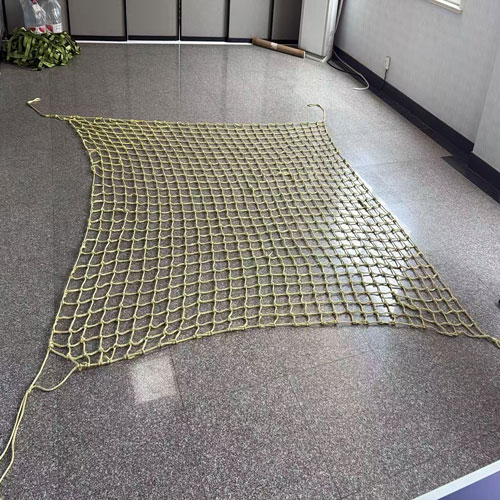
China Lifute Sling Group manufacture Anti Drone net,Anti-drone mesh,Drone protection nets,Aramid rope Anti Drone net,Aramid Braided Rope Knotted Anti-Drone Net,Aramid Knotted Anti-Drone Net,Knotted Aramid Braided Rope Anti-Drone Netting,Braided Knotted Para-Aramid Anti-Drone Barrier Net.
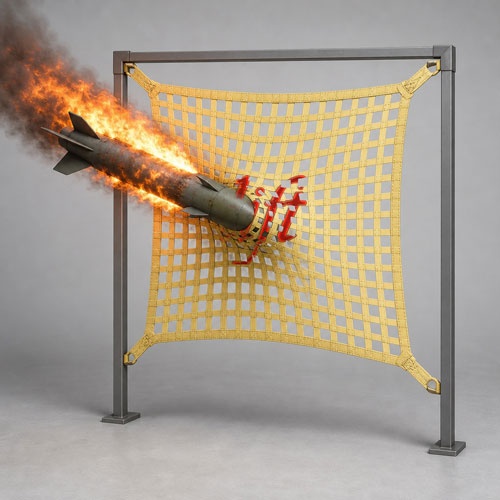
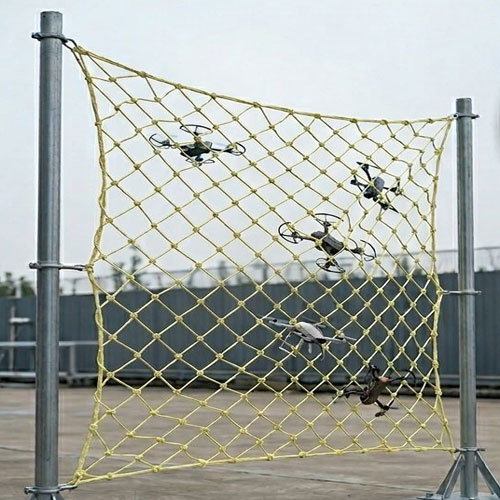
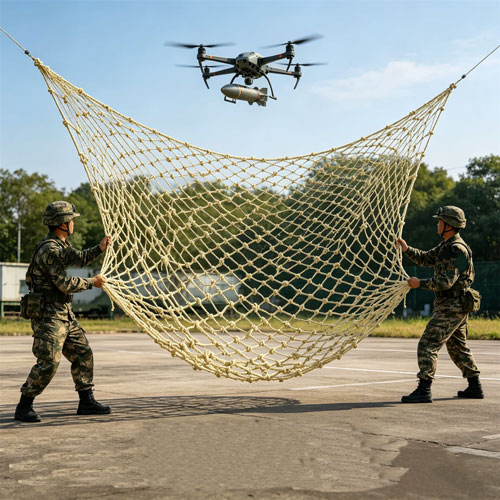
Anti-Drone Net is a high-performance physical barrier engineered with 100% aramid (Kevlar®-grade) fiber, purpose-built for critical infrastructure, military installations, prisons, airports, stadiums, and high-security perimeters. Designed to neutralize unauthorized UAV intrusions, this net delivers unmatched cut resistance, tensile strength, and long-term durability in all-weather conditions.
Why conventional net-making methods fail with aramid fiber:
Aramid fiber is renowned for its exceptional strength-to-weight ratio, heat resistance, and cut resistance — but it also has a defining characteristic: extremely low elongation at break. Unlike polyester or nylon, aramid fiber stretches very little before fracturing.
This low extensibility creates a critical manufacturing constraint:
Method | Problem |
Twisted rope construction | Under tension, the rigid aramid filaments grind against one another at every twist point. The fibers literally cut into each other, causing progressive internal abrasion and catastrophic strength loss — often 30–50% below the fiber’s rated capacity. |
Knotless / knot-free net weaving | In knotless mesh structures (e.g., Raschel-knitted nets), aramid yarns are inter-looped under constant friction. The same self-abrasion mechanism occurs — filaments sever their neighbors at contact nodes, producing a net far weaker than the sum of its fibers. |
Direct braiding into net form | Attempting to braid aramid filament directly into net geometry without first forming a proper rope creates uneven load distribution and localized stress points where fibers cut through one another. |
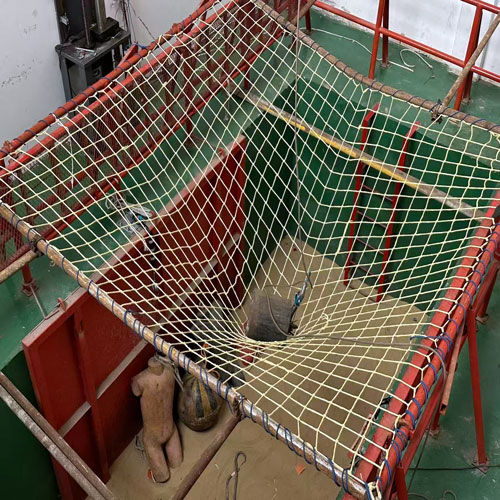
We employ a two-stage manufacturing process specifically developed for aramid fiber:
1. Stage 1 — Specialized Braided Rope Production:
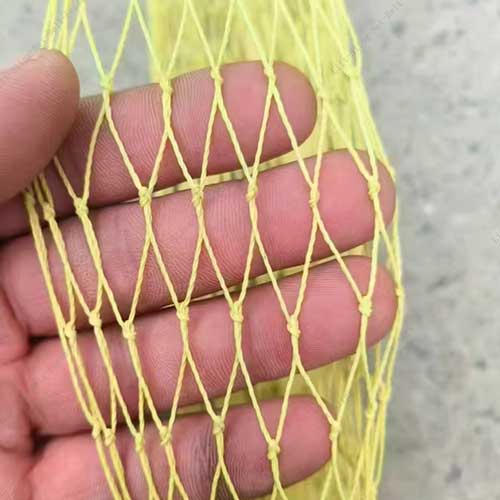
• Each rope is formed using a precision-controlled braiding process (not twisting) that lays aramid filaments in parallel-helical paths with a protective geometry.
• Eliminates internal fiber cross-cutting by maintaining controlled filament alignment.
• Distributes tensile load evenly across every individual filament.
• Preserves 100% of the aramid fiber’s rated tensile strength.
• Produces a rope with a smooth, low-abrasion surface.
2. Stage 2 — Knotted Net Assembly:
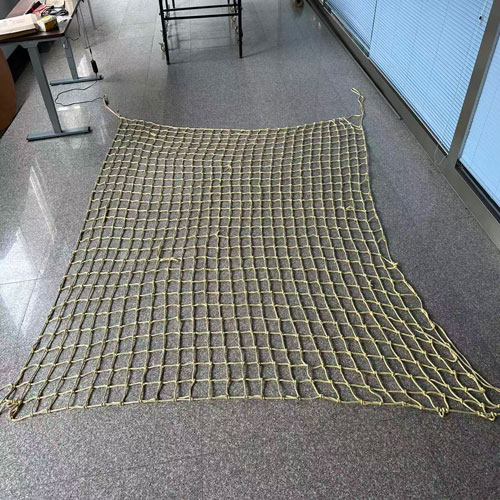
• The braided aramid ropes are hand-knotted into a net using reinforced knotting techniques.
• Load paths are linear and predictable (knot → straight rope segment → knot).
• Knots act as intentional, engineered node points rather than random friction contact zones.
• Mesh size is uniform and customizable (standard: 50 mm × 50 mm to 200 mm × 200 mm).
• Damaged sections can be repaired in the field by re-knotting.
The result: For any given quantity of aramid fiber, our Anti-Drone Net achieves the maximum possible structural strength — no fiber is wasted on internal self-destruction.
Property | Specification |
Material | 100% Para-aramid fiber (Kevlar® 29 / equivalent) |
Rope construction | Precision-braided, non-twisted |
Net assembly | Hand-knotted, tension-set knots |
Mesh size | Customizable: 20 mm – 200 mm (standard: 50 / 100 / 150 mm) |
Rope diameter | 4 mm / 6 mm / 8 mm / 10 mm / 12 mm |
Tensile strength (rope) | ≥ 3,620 MPa (fiber-level); rope strength varies by diameter |
Elongation at break | 2.4% – 3.6% |
Density | 1.44 g/cm³ |
Max continuous service temp. | 200°C |
Decomposition temperature | > 500°C |
UV resistance | Good; optional UV-stabilized coating available |
Chemical resistance | Excellent resistance to most organic solvents, oils, and fuels |
Cut resistance | EN 388 Level 5 / ANSI A5–A7 (rope-diameter-dependent) |
Net dimensions | Fully customizable; seamless joins for large perimeters |
Edge finishing | Reinforced border rope with stainless steel or galvanized eyelets |
Installation hardware | Optional: tensioning cables, turnbuckles, anchor plates, quick-release pins |
Unlike twisted or knotless aramid nets that sacrifice 30–50% of fiber capacity to internal abrasion, our braided-rope + knotted-net process retains virtually all the fiber’s rated strength. A lighter net can provide the same stopping power — critical for rapid-deployment and temporary-perimeter applications.
Aramid fiber is inherently cut-resistant, and our braided rope construction amplifies this property. The dense, parallel-helical filament arrangement presents no weak angle for blades or propellers to exploit. Independent testing confirms the net withstands repeated drone-propeller strikes without structural compromise.
When a knotted aramid net eventually reaches its ultimate load, failure is localized and visible — individual knots or rope segments break at identifiable points. Inspection teams can verify net integrity with confidence, unlike knotless nets where internal abrasion damage is invisible until catastrophic failure occurs.
Damaged mesh sections can be cut out and re-knotted on-site using spare braided rope. No specialized equipment or factory return is required — a critical advantage for deployed military and remote infrastructure sites.
Aramid fiber’s density is approximately 40% lower than steel wire of equivalent strength. A 100 m² anti-drone net (6 mm rope, 100 mm mesh) weighs approximately 12–18 kg — easily transported and deployed by a two-person team.
Company:China Lifute Sling Group
Contact:Mss Wang
Tel:+8613365203036
Mobile:+8613365203036
E-mail:cnlift@126.com
Address:TaiZhou City, JiangSu Province, Lifute District ,China