语言选择: 


Meta title: Fire Resistant Drone Anti-Collision Net — Why Choose Flame-Retardant Aramid Fibre Safety Net
Meta description: A drone strike is an impact and a fire. Flame-retardant aramid fibre gives a drone anti-collision net impact cushioning, roughly twice the strength of high-strength polyester, low weight and a rope that will not burn through. 6 mm rope: 2.6 t breaking strength. 10 mm rope: 7 t.
Ask a buyer what a drone anti-collision net is for and most will say "to stop the drone." That is only half the answer.
A drone that has just been intercepted is a damaged airframe with a lithium pack that has been crushed, shorted or punctured. The impact is over in milliseconds. The fire is not. A net that absorbs a 100 km/h strike perfectly and then burns through in the next ninety seconds has not protected anything — it has postponed the incident by a minute and a half, and it has done so at the exact moment when nobody can get near the panel to do anything about it.
That is why, on this product, fire resistance is not an optional upgrade you discuss after the price. It is the property that decides whether the interception stays a success.
This is the case for a flame-retardant aramid fibre safety net — and for the rope construction that makes the fibre's strength actually available when the strike arrives.
Heat reaches a drone barrier from three directions, and any one of them is enough to end the protection:
1. The drone itself. Impact-damaged lithium cells vent, ignite and burn at very high temperature, directly against the mesh that just caught them.
2. The site behind the net. Plant rooms, exhaust zones, flue-adjacent elevations, solar-exposed façades and industrial roofs are all hot environments. A net that softens in normal service condition is already degrading before any drone arrives.
3. Escalation. If the barrier itself can burn, the net becomes fuel. A security barrier that feeds a fire, or that melts into droplets and falls as burning debris onto the asset it was installed to protect, is a liability rather than a protection.
Para-aramid fibre answers all three. It does not melt, it does not drip, it does not support combustion, and it self-extinguishes when the ignition source is removed. Where a polypropylene or standard polyester net softens, sags and burns through, an aramid rope net holds its shape and keeps the intercepted airframe inside the controlled footprint while it burns out.
For a substation bay, a prison perimeter, a fuel-adjacent installation or any site where the drone threat is a battery-powered UAV, that single property is worth the entire specification.
Property | What it means on a drone barrier |
Flame retardant | Does not melt, does not drip, does not sustain combustion — the barrier cannot become fuel |
Impact cushioning | The mesh deflects and spreads the strike across many ropes and knots, lengthening the deceleration distance and time instead of concentrating the load at one contact point |
Very high tensile strength | Roughly twice the strength of high-strength polyester fibre — more protective capacity per rope |
Lightweight | A lighter panel carries the same rated load, so the anchor points, tensioning cables and host structure carry less |
Low elongation | The mesh holds its shape, does not balloon away from the protected face in wind, and does not creep |
Cut and abrasion resistance | The rope resists being sliced by a spinning propeller or a carbon-fibre arm instead of being cut through |
Chemical and UV resistance | Suits industrial, transport and permanent outdoor installations; UV-stabilised coating available |
Two of these deserve to be spelled out, because they are the two that buyers most often misread.
"Cushioning" is not softness. Aramid is not chosen because it is gentle — it is chosen because the mesh deforms in a controlled way. The panel deflects, the load spreads across dozens of knots and rope segments, and the airframe decelerates over a distance instead of being stopped at a single point of contact. Energy absorbed over distance and time is what keeps the rope from being cut. A rigid barrier concentrates everything on one impact point, which is how a barrier gets penetrated rather than loaded.
Lightweight is a structural saving, not a cosmetic one. Because para-aramid delivers more strength per unit weight, a net built to the same rated load is lighter — and every kilogram removed from the panel is a kilogram that does not have to be carried by the eyelets, the tensioning cables, the frame and the building. On a glazed façade, a lightweight roof or a demountable event structure, that is often what makes the installation possible at all.
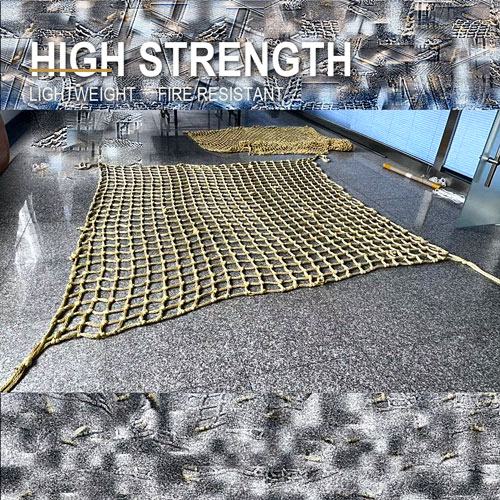
Here is the engineering point that separates a serious aramid barrier from an expensive one.
Para-aramid has very low elongation. That is exactly why the mesh keeps its shape and does not sag or creep — and it is also exactly why ordinary net-making methods waste aramid. Filaments that barely stretch will grind and shear against each other wherever they bear on one another under load.
In a knotless mesh or a twisted-rope structure, that is a structural problem, not a cosmetic one:
· Every crossing point is a contact zone where filament bears directly on filament.
· Under impact, those contact zones work as cutting edges — fibres cut across each other and abrade inside the rope.
· The loss happens before the load ever reaches the anchors. You paid for the fibre and never got to use all of it.
· The damage is internal and progressive. A knotless structure gives no observable failure point until it lets go.
Put simply: the load has to be carried by something that does not damage the rope that is carrying it. That is a construction question, and it is why we do not build these nets like ordinary nets.
Our drone anti-collision nets are built in two deliberate stages.
Stage 1 — special braiding into high-strength round rope or flat webbing. Using a dedicated braiding process, the aramid filaments are laid in parallel-helical paths rather than being twisted. They stay aligned instead of being forced to cut across one another at every turn. The result is a high-strength round rope — or flat webbing where the application calls for it — that keeps the fibre's strength instead of spending it on internal abrasion.
Stage 2 — weave that rope into a strong mesh grid. The braided rope is knotted into a mesh panel, so every knot is a structural node and every load path runs knot → straight rope segment → knot. The panel becomes a flexible, self-distributing soft barrier wall rather than a rigid screen: it gives, spreads the strike, entangles the rotors and brings the airframe down inside a controlled footprint.
Three practical consequences follow:
· The strength is where you specified it. Load paths are straight, so the rope's rated breaking strength reaches the anchors instead of being consumed at contact zones.
· Inspection is possible. When the panel finally reaches its limit, it fails at a point you can see and record — a knot or a rope segment. For a permanent barrier that has to be signed off after every incident, that matters as much as the headline strength.
· Repair happens on site. A damaged section is cut out and re-knotted with spare braided rope and hand tools. No factory return, no elevation out of service.
Strength starts at the rope, so here are the figures.
Braided aramid rope | Breaking strength |
6 mm | 2.6 t |
10 mm | 7 t |
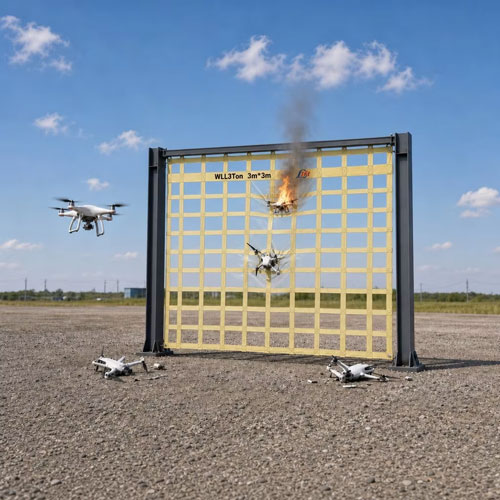
The first number is what most drone protection needs. A 6 mm braided para-aramid rope rated at 2.6 tonnes breaking strength, hand-knotted into a controlled-aperture mesh and tensioned across the span, is already a very serious barrier against consumer, commercial and FPV-class UAVs — and it does it at a weight that a façade, a frame or a demountable structure can carry.
The second number is a different class of product entirely. Scale the same construction up to 10 mm braided aramid rope at 7 tonnes breaking strength per rope, knot it into a dense mesh and anchor it properly, and the soft barrier wall is now built for high-energy threats: loitering munitions and incoming missile threats approaching the protected asset, where the requirement is no longer "catch a falling drone" but "stop a fast, heavy, burning object before it reaches the target."
Two points of honesty about scaling, because they are what separate a real specification from a brochure:
1. System capacity is not one rope's capacity. The panel works as a mesh — capacity is built from the number of rope load paths the strike engages, the aperture, the standoff distance and the anchoring detail. We size the panel to your threat, not to a catalogue number.
2. Aperture sets what cannot pass. The mesh has to present closed geometry to the smallest threat you care about. We supply apertures from 20 mm to 200 mm (standard 50 / 100 / 150 mm) and recommend one once you tell us the drone or munition classes and the span.
· Critical infrastructure — substations, transformer bays, water and telecom sites
· Military, defence and forward positions — see our Aramid Kevlar anti-drone nets for military & defence (https://www.xssling.com/safety-rope-net/1379.html)
· Prisons and secure facilities — continuous, inspectable panels against contraband delivery
· Airports and airfields — boundary and approach screening against unauthorised UAV incursion
· Stadiums, arenas and event perimeters — temporary or demountable spans
· Industrial roofs, plant rooms and solar arrays — hot environments where a polyester net would degrade
· Bridges, viaducts and heritage façades — low visual and wind penalty
For the full technical route, see our drone anti-collision net (https://www.xssling.com/safety-rope-net/1474.html), the anti drone net (https://www.xssling.com/safety-rope-net/1455.html) range, the high strength aramid drone defence rope net (https://www.xssling.com/safety-rope-net/1440.html), and the purpose-built fire-resistant, high-temperature resistant rope netting for drone interception (https://www.xssling.com/safety-rope-net/1376.html).
Item | Range / standard |
Material | 100% para-aramid fibre (Kevlar®-grade) |
Rope construction | Precision-braided, non-twisted — round rope or flat webbing |
Rope diameter | 4 / 6 / 8 / 10 / 12 mm |
Rope breaking strength | 6 mm: 2.6 t · 10 mm: 7 t (other sizes on request) |
Mesh assembly | Hand-knotted, tension-set knots |
Mesh aperture | 20 mm – 200 mm; standard 50 / 100 / 150 mm |
Panel size | Made to order; large perimeters supplied as seamless joined panels |
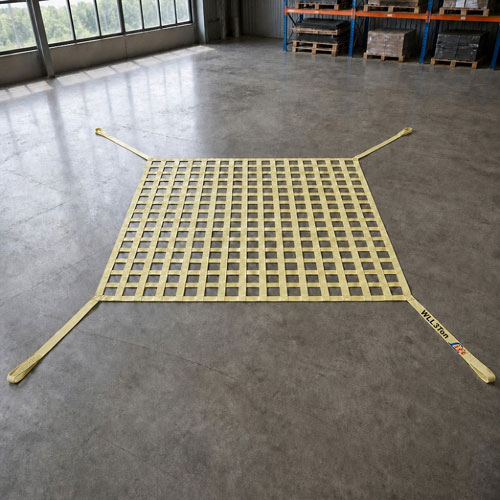
Edge finish | Reinforced border rope with stainless steel or galvanised eyelets |
Fire behaviour | Does not melt, does not drip, does not sustain combustion |
Elongation | Very low — mesh holds shape under wind and impact |
Coating | UV-stabilised coating available for permanent outdoor use |
Hardware | Optional tensioning cables, turnbuckles, anchor plates, quick-release pins |
Kevlar is a registered trademark of DuPont. Our nets use para-aramid fibre of this grade or equivalent.
Lift Sling Net Belt Factory manufactures braided aramid rope, webbing and knotted rope nets for drone protection, safety and lifting applications. We braid our own rope, knot our own panels and build to the installation rather than to a stock list — OEM and private-label supply are both available. Small sample panels or sample rope can be supplied for evaluation before you commit to a full elevation.
To quote and draw your panel we need:
3. Finished aperture width × height, and whether the panel is flat or follows a curve.
4. The drone or munition classes you need to stop — this sets the mesh aperture.
5. Rope diameter (4 / 6 / 8 / 10 / 12 mm), or the impact energy the panel must absorb.
6. Fixing method: cable and turnbuckle, steel frame, or direct anchor to the structure.
7. Eyelet spacing and border-rope diameter.
8. Colour, UV-stabilised coating and any marking or labelling required.
Panels ship with a reinforced border rope and eyelets, folded, bagged and labelled, with a panel drawing for the installation team.
Send us the span, the threat class and the fixing method — we will come back with a rope diameter recommendation, a panel drawing and a quotation.
Order online (https://www.xssling.com/custom/) | Contact us (https://www.xssling.com/contactus/) | Send an enquiry (https://www.xssling.com/feedback/)
Lift Sling Net Belt Factory — Contact: Mss Wang | Tel / WhatsApp: +8613365203036 | E-mail: cnlift@126.com | Address: TaiZhou City, JiangSu Province, China
Does an aramid drone net really not burn?
Para-aramid does not melt, does not drip and does not sustain combustion; it self-extinguishes once the ignition source is removed. It will char under prolonged direct flame, but it does not become fuel and it does not fall away as burning droplets — which is what keeps the intercepted airframe inside the controlled footprint.
Why is braided rope used instead of twisted rope?
Because para-aramid has very low elongation, twisted and knotless structures make the filaments cut and abrade against each other wherever they bear on one another, consuming part of the rated strength before the load reaches the anchors. Braiding keeps the filaments aligned; knotting creates clean structural nodes. Load travels knot → straight rope segment → knot.
What breaking strength is available?
Braided aramid rope is supplied across 4 / 6 / 8 / 10 / 12 mm, with 6 mm rated at 2.6 t and 10 mm rated at 7 t breaking strength. Panel capacity is then a function of rope diameter, aperture, span, standoff and anchoring — we size it to your threat.
Can a 10 mm 7 t net stop missiles?
A 10 mm braided aramid rope at 7 t per rope, knotted into a dense mesh and properly anchored, is the construction used for high-energy interception — loitering munitions and incoming missile threats against a protected asset. Interception is a system result: mesh aperture, standoff, span and anchoring all have to be engineered together. Send us the threat and the geometry and we will specify it.
Can the net be repaired after an incident?
Yes. Because the panel is knotted, a damaged section is cut out and re-knotted on site with spare braided rope. No factory return and no special equipment are required.
Related reading: Drone anti-collision net (https://www.xssling.com/safety-rope-net/1474.html) · Fire-resistant, high-temperature resistant rope netting for drone interception (https://www.xssling.com/safety-rope-net/1376.html) · High strength aramid drone defence rope net (https://www.xssling.com/safety-rope-net/1440.html) · Aramid Kevlar anti-drone nets for military & defence (https://www.xssling.com/safety-rope-net/1379.html) · Aramid Kevlar anti-drone security netting (https://www.xssling.com/safety-rope-net/1436.html) · Drone safety net (https://www.xssling.com/safety-rope-net/1446.html)
Company:China Lifute Sling Group
Contact:Mss Wang
Tel:+8613365203036
Mobile:+8613365203036
E-mail:cnlift@126.com
Address:TaiZhou City, JiangSu Province, Lifute District ,China