语言选择: 


What Is a High Strength Anti drone net?
By China Lifute Sling Group · 27 October 2026 · 6 min read
A high strength anti drone net is a passive physical barrier: a mesh panel hung across the flight path a small unmanned aircraft would use, with an aperture small enough to catch the aircraft and joints strong enough to hold it once caught. There is no radar, no jammer and no operator in the loop — the net simply refuses to let the drone through.
China Lifute Sling Group makes this net from high-strength Kevlar webbing or braided aramid rope. Three properties matter and all three are built in on purpose: it is very strong for its weight, it is light enough for two people to handle a large panel, and it does not burn through — aramid has no melting point in service, it carbonises at around 400 °C and keeps its shape, which is exactly what you want when the drone that arrives is already on fire.
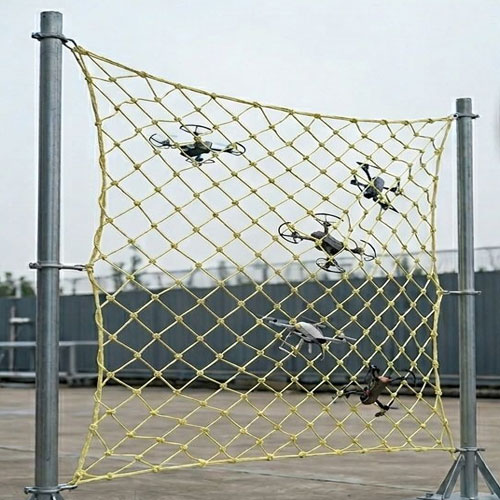
[图 1]A high strength anti drone net in service: the mesh takes the aircraft, the border rope takes the mesh, the posts take the border.(源文件 img1.jpg,225×225)
The aramid is braided, not bought in
The rope in this net is not commodity line that gets knotted in a workshop. Aramid fibre is braided on our own machines to a process developed for this product — 12 strands interwoven rather than twisted, with no core. That construction stays round under load instead of flattening into an oval, it cannot unlay if a strand is cut, and, the part that matters here, it keeps its strength as it turns through the curvature of a knot. A twisted rope loses more in the knot, because its lay opens under load and the strands stop sharing the bend.
The numbers start at the rope
Two figures define the material. A 6 mm aramid rope breaks at 2.6 t on a single-strand straight pull. A 10 mm aramid rope breaks at 7 t under the same test. Every consignment is tested, so the batch certificate governs — not a brochure.
But a net is not judged on its rope. It is judged on the joint, because a net has hundreds of joints and only one rope.
Knotted into a net, the joint is worth about four times the rope
Count the rope ends going into one knot on our panel: four. Each mesh leg ends in a knot that wraps around its own turns, so load arriving from one direction passes through the curvature of the knot and leaves through the other three legs. It never travels through rope sliding on rope, and it is never gripped by a device that can slip.
That is where the multiplier comes from, and it is arithmetic, not marketing: a clamp holds one rope end; a knot holds four and lets them share. On a 10 mm panel the knot node tests at about 27 t — roughly four times what the same rope delivers in a clamped joint, and, as the next section shows, several times what a much thicker steel wire rope can take before it breaks at all.
A knot also decides how the net fails. One mesh takes the hit, the neighbouring meshes hold through defined knots, and the panel can be re-knotted on site and put back into service. A clamped or knotless panel tends to unzip from the point of impact along the line of least resistance.
Now put a 12 mm steel wire rope beside it
A 12 mm steel wire rope breaks at about 7 t. One knot of our 10 mm aramid net holds about 27 t. Read those two lines together: a joint the size of a fist in a light aramid net carries nearly four times what an entire 12 mm steel wire rope can take before it parts.
That is the comparison that matters, because the steel wire net does not get to use its rope either. It has to pass that rope through a joint.
The market alternative: aluminium tube riveted onto 7×7 stainless
Most “anti drone nets” sold today are 7×7 construction 304 stainless wire rope, with the mesh formed by riveting an aluminium tube over the crossing — or, on the heavier builds, an aluminium ferrule pressed onto each rope end. The values quoted for that product family look reasonable until you line the joint up against the rope:
7×7 304 stainless wire rope against the riveted aluminium joint that forms its mesh
Wire rope Ø | Single rope, break | Riveted aluminium joint, limit |
2 mm | ≈ 3.2 kN (326 kg) | ≈ 2.5–2.9 kN (255–296 kg) |
3 mm | ≈ 7.4 kN (755 kg) | ≈ 5.9–6.7 kN (600–683 kg) |
4 mm | ≈ 12.5 kN (1.27 t) | ≈ 10–11 kN (1.0–1.1 t) |
The joint runs at 78–90 % of the rope, which sounds acceptable — until you notice the absolute numbers. The heaviest joint in that table holds about 1.1 t. Our 10 mm aramid knot holds about 27 t. That is roughly twenty-four times the joint capacity, in a net that a person can carry.
And on the bigger 12 mm builds the problem gets worse rather than better: a 12 mm wire rope breaking at 7 t needs a joint that can hold 7 t to be worth anything, and a riveted aluminium tube made up on site is neither tested node by node nor capable of that figure in service.
Why a riveted steel wire net is not an interception net
Interception is not a static load case. A drone arrives with kinetic energy, and the net has one short distance — the sag in the panel — in which to take that energy away.
Take a 10 kg airframe at 25 m/s. Its kinetic energy is about 3.1 kJ. Absorb that over the 100 mm a taut panel can give, and the average force on the mesh is roughly 31 kN — about 3.2 t, with peaks well above it as the mesh tightens.
Now compare:
· 2 mm riveted joint, 2.5–2.9 kN: fails on contact.
· 3 mm riveted joint, 5.9–6.7 kN: fails.
· 4 mm riveted joint, 10–11 kN: fails — the panel needs three times that joint.
· 10 mm aramid knot, ≈ 27 t (≈ 265 kN): holds, with margin, and spreads the hit across the neighbouring meshes.
Even a 2 kg drone at 30 m/s produces about 9 kN over the same 100 mm — already at the limit of the strongest aluminium joint in the table, and under 4 % of what one aramid knot carries. This is why a riveted stainless net can look convincing in a photograph and still be ineffective in the one event it was bought for: it is not the rope that fails, it is every joint in the impact zone, one after another.
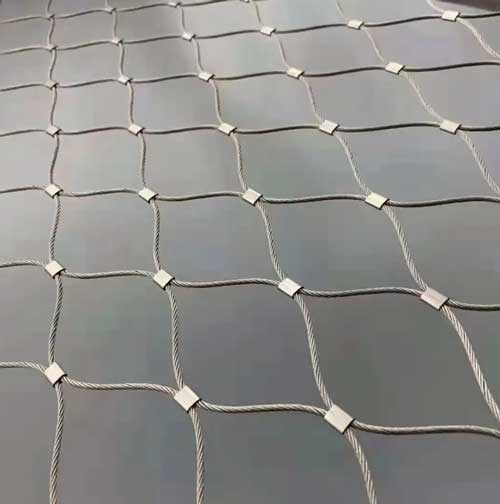
[图 2]A knotted aramid panel taking the hit: the struck mesh pulls its neighbours through defined knots instead of unzipping along a line of riveted joints.(源文件 img2.jpg,225×225)
From a 27 t node to a twenty-tonne panel
A joint value is not a panel value, but here the arithmetic runs in the buyer’s favour. Ten legs cross every metre of width in a 100 mm mesh, in both directions. Built from 10 mm rope with a knot node at about 27 t, a full panel is calculated in the twenty-plus tonne class; halve the mesh and the number of load paths doubles again.
At that level the net changes category. It is no longer a screen against a hobby quadcopter — it is the class of structure that can be engineered against a fast, heavy airframe, and in defence work against a loitering munition or a missile seeker, where the impact energy has to be arrested inside the panel rather than passed through it.
One honest qualification. The twenty-tonne figure is engineering arithmetic on tested rope and knot values, not a certificate for a named threat. Whether a particular projectile is stopped depends on the mesh, the panel geometry, the stand-off and the anchors, so every defence enquiry is quoted and, where required, proof-tested per project. We would rather answer that question with a test report than with an adjective. |
Where a net like this is specified
· Airports, helipads and approach zones, as one layer of a wider counter-UAS design
· Prisons and correctional sites, where the driver is contraband delivery by air
· Refineries, tank farms and fuel depots, where a burning drone is the second hazard
· Stadiums and event sites, for crowd protection and defined flight boxes
· Data centres, substations and water treatment works, against a dropped payload or a crashed airframe
· Ports, terminals and industrial roofs, where a large opening is closed with joined panels
· Military and defence sites, quoted against the stated threat
About China Lifute Sling Group
China Lifute Sling Group has manufactured rope, net and rigging products in Taizhou, Jiangsu for four decades. We braid our own aramid, knot the mesh and splice the border in one works, so the joint strength quoted is the joint strength supplied. Panels are made to 5 × 10 m, 10 × 10 m and 10 × 20 m as standard, and to drawing beyond that, in mesh from 40 to 120 mm, with corner eyes, stainless thimbles or eyelets at your anchor spacing.
Send us the opening, what it fixes to, the stand-off behind it and the aircraft you are designing against, and we will come back with rope diameter, mesh, panel layout and border specification — with the break load at the knot, not just on the reel.
|
Quick answers
Is a high strength anti drone net the same as a steel wire net?
No. Both are rope nets; they differ at the joint. A riveted aluminium tube holding 7×7 stainless wire gives 0.25–1.1 t per joint depending on rope size, while a knotted aramid node on a 10 mm panel holds about 27 t. Since a drone impact loads the joints, not the rope, that difference decides whether the net intercepts or simply gets hit.
Does the net burn?
No. Aramid does not melt in service; it carbonises from about 400 °C and keeps its geometry, so it neither drips nor opens a hole over the asset below.
Can it be repaired after an interception?
Usually yes — a local repair with the same braid, recorded on the panel tag. A damaged border or a pulled corner is replaced rather than patched.
Company:China Lifute Sling Group
Contact:Mss Wang
Tel:+8613365203036
Mobile:+8613365203036
E-mail:cnlift@126.com
Address:TaiZhou City, JiangSu Province, Lifute District ,China