语言选择: 


Meta title: Drone Anti-Collision Net: Rope Strength, Heat and Fire Performance Come Before Price
Meta description: A drone anti-collision net is judged by one thing: whether it still stops the drone. Here is why rope strength, high-temperature resistance and fire resistance matter more than the lowest quote.
When "drone netting" lands on a procurement list, the conversation usually starts in the same place: price per square metre. It is a natural reflex. It is also the wrong first question.
There is a hard logic hiding behind it. If price is the only criterion, the cheapest net in the world is the one you never buy — that costs nothing at all. The moment you decide the asset needs protecting, you have already accepted that the net has a job to do. The only question left is whether the net you hang in front of that asset can actually do it.
A drone anti-collision net is not a decorative screen. It is the last few metres of protection between a flying object carrying a lithium battery and whatever sits behind it — a transformer bay, a prison yard, an apron edge, a plant room, a crowd. If the net is penetrated, the drone does not politely fall away. It arrives at the protected face with its kinetic energy still largely intact, and then the second event happens: impact, rupture, fire.
That is what a cheap specification buys you.
Compare two budgets.
The first buyer pays for a knotless, low-strength net. It arrives, it goes up, it looks the part. On the first serious strike, the mesh gives way at the contact point. The airframe passes through and hits the asset behind it. Now the cost is not the net — it is the outage, the fire damage, the downtime, the emergency response, the insurance conversation, and a replacement net bought under time pressure at whatever price happens to be available.
The second buyer pays more per square metre for a high-strength, high-temperature-resistant, flame-resistant net. It takes the strike, absorbs the energy, tangles the rotors, and drops the drone inside a controlled footprint. The only follow-up cost is an inspection and, if needed, a section re-knotted on site.
The second buyer spent more on the net and less on the event. Price per square metre is a small number. Cost of failure is not.
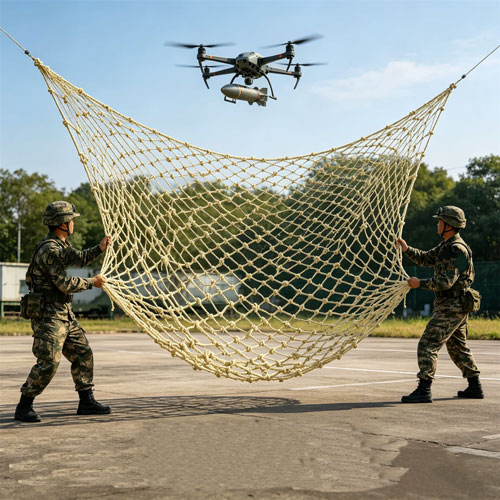
Low-strength and knotless nets do not fail all at once — they fail in three recognisable ways, and all three end with the drone reaching the protected asset.
1. The mesh is cut, not caught. A spinning propeller edge or a carbon-fibre arm is a cutting tool. If the rope cannot resist slicing, the impact cuts the strands and the airframe continues through the hole it just made. The net stopped nothing; it delayed nothing.
2. The impact concentrates at a single point. In a low-strength net the load does not spread across the mesh — it tears locally. Once the first aperture opens, its neighbours unzip. The panel is still standing and completely useless.
3. Heat finishes what the impact started. A drone that has just been stopped is a drone with a damaged, shorted or punctured lithium pack. That is a fire. If the rope softens, melts or burns through at that temperature, the net fails after the collision succeeded — and the burning airframe drops through, or lands on the asset anyway.
The purpose of an anti-collision net is not "the drone did not get through the mesh." It is the drone did not reach the thing behind the mesh. A net that lets the drone arrive at the protected face has not done its job, whatever it cost.
The protective capacity of a drone anti-collision net (https://www.xssling.com/safety-rope-net/1474.html) is the capacity of its rope multiplied by the number of load paths the mesh can mobilise. That is why the material matters more than any other line on the specification sheet.
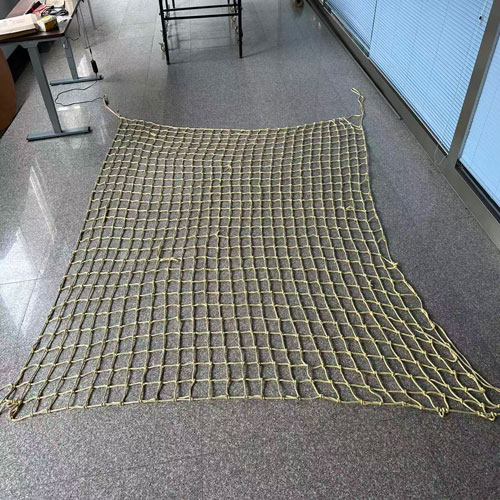
Our nets are made from 100% para-aramid fibre (Kevlar® 29 grade or equivalent) — chosen for high tensile strength at low weight. Less weight per square metre means less load carried by the anchor points and the host structure, which matters on a glazed façade, a lightweight frame or a rooftop installation. Strength you don't have is strength that isn't there when the strike happens; weight you don't have is steel and anchor money you don't have to spend.
A drone collision is a thermal event as much as a mechanical one. Heat arrives from three directions: from the battery pack igniting after impact, from the hot industrial environment the net is mounted in (plant rooms, exhaust zones, solar-exposed elevations), or from direct flame if the incident escalates.
A rope that loses its strength as temperature climbs has already lost the argument at exactly the wrong moment. Para-aramid holds its performance at high continuous service temperatures, which is why we specify it where a polyester or polypropylene net would soften and sag. We confirm the working temperature range against your site conditions and state it on the panel drawing — a temperature figure is only useful if it matches your environment.
This is the property most often left off the enquiry sheet, and it is the one that decides whether a successful interception stays successful.
A net that stops a drone and then burns through is not a net; it is a delay. Flame-resistant aramid rope does not support combustion and does not melt into droplets, so the intercepted airframe stays inside the controlled footprint while it burns out instead of passing through the mesh onto the asset it was meant to protect. See our fire-resistant, high-temperature resistant rope netting for drone interception (https://www.xssling.com/safety-rope-net/1376.html) for how that specification is built.
Fire performance is not optional if your site has any of the following:
· Lithium-battery drones as the expected threat
· Combustible or high-value equipment directly behind the net
· Hot process areas, flue-adjacent elevations or high solar loading
· A requirement that the barrier itself does not become fuel
There is a construction reason behind the strength argument, and it is worth understanding before you specify.
Para-aramid has very low elongation — roughly 2.4% to 3.6% at break. That is a feature: the mesh keeps its shape, does not balloon in wind, and does not creep away from the protected face. But low elongation is exactly why ordinary rope-making ruins aramid. Filaments that barely stretch will grind and shear against each other wherever they cross under load.
Twisted rope and knotless mesh create contact zones where the fibre bears directly on itself. Under a hard impact, that internal abrasion consumes part of the rated strength before the load ever reaches the anchors. You paid for the fibre; you never got to use all of it.
Our construction is two-stage:
1. Precision-braided rope. Filaments follow parallel-helical paths instead of being twisted, so they stay aligned rather than cutting across one another at every turn.
2. Hand-knotted mesh. The braided rope is hand-knotted so every knot is a deliberate structural node. Each load path runs knot → straight rope segment → knot, with no friction-contact transfer zones.
It also gives you a failure mode you can inspect. When a knotted net reaches its limit, it breaks at a point you can see and record. Knotless structures hide internal abrasion until they let go. For a permanent barrier that has to be signed off after every incident, that difference is worth as much as the headline strength figure.
And it is repairable in place: a damaged section is cut out and re-knotted on site with spare braided rope and hand tools. No factory return, no elevation taken out of service.
We build to the installation, not to a catalogue number. To quote and draw the panel we need:
3. Finished aperture width × height, and whether the panel is flat or follows a curve.
4. The drone classes you need to stop — this sets the mesh aperture (we supply 20 mm – 200 mm; standard 50 / 100 / 150 mm).
5. Rope diameter (4 / 6 / 8 / 10 / 12 mm) or the impact energy the panel must absorb.
6. Fixing method: cable and turnbuckle, steel frame, or direct anchor to the structure.
7. Eyelet spacing and border-rope diameter.
8. Colour, UV-stabilised coating and any marking or labelling required.
Panels ship with a reinforced border rope and eyelets, folded, bagged and labelled, with a panel drawing for the installation team. Large perimeters are supplied as seamless joined panels, so there are no weak intermediate seams on the protected face. Sample panels or sample rope can be supplied for evaluation before you commit to a full elevation.
Send us the span, the drone classes and the fixing method — and we will come back with a rope diameter recommendation, a panel drawing and a quotation. If you are still at concept stage, tell us the asset and the drone classes and we will propose the specification.
Order online (https://www.xssling.com/custom/) | Contact us (https://www.xssling.com/contactus/) | Send an enquiry (https://www.xssling.com/feedback/)
China Lifute Sling Group — Contact: Mss Wang | Tel / WhatsApp: +8613365203036 | E-mail: cnlift@126.com | Address: TaiZhou City, JiangSu Province, Lifute District, China
· Anti drone net (https://www.xssling.com/safety-rope-net/1455.html) — the aramid braided-rope knotted anti-drone net range
· Drone safety net (https://www.xssling.com/safety-rope-net/1446.html)
· High strength aramid drone defence rope net (https://www.xssling.com/safety-rope-net/1440.html)
· Aramid Kevlar anti-drone nets for military & defence (https://www.xssling.com/safety-rope-net/1379.html)
· Fire-resistant, high-temperature resistant rope netting for drone interception (https://www.xssling.com/safety-rope-net/1376.html)
· Aramid Kevlar anti-drone security netting (https://www.xssling.com/safety-rope-net/1436.html)
· Company profile (https://www.xssling.com/companyprofile/)
Company:China Lifute Sling Group
Contact:Mss Wang
Tel:+8613365203036
Mobile:+8613365203036
E-mail:cnlift@126.com
Address:TaiZhou City, JiangSu Province, Lifute District ,China