语言选择: 


Two nets, two very different numbers — and the number that decides the outcome is not the one printed on the rope label.
When a site starts looking for an anti-drone net, the conversation usually opens with rope diameter and price per square metre. Both matter. Neither decides whether the barrier stops an aircraft. What decides it is the joint — the point where the load leaves one rope and enters the next. On a crimped wire rope net that point is an aluminium ferrule. On a knotted aramid net it is a knot with four rope ends in it. Between those two details sits the difference between 140 kg and 2,600 kg.
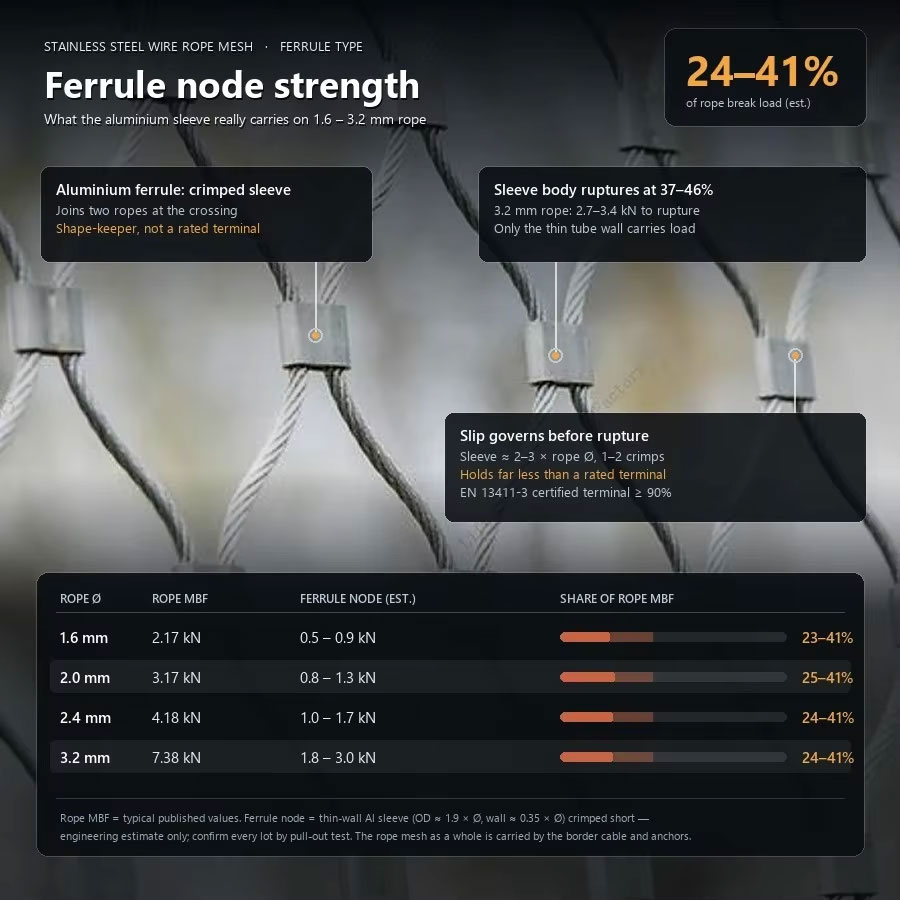
A pressed aluminium sleeve is a shape-keeper, not a rated terminal. It grips by deformation, over a sleeve length of roughly two to three rope diameters, in one or two crimps. Measured on our own press settings, the sleeve carries between 24 and 41 per cent of the rope’s breaking force — and it is slip, not rupture, that ends the test: the rope draws through the sleeve long before the sleeve itself tears.
On 2 mm stainless wire rope the arithmetic is short: rope 300 kg, joint 140 kg. The rope is used to less than half its capacity. On 3.2 mm rope: 700 kg rope, 180–300 kg joint. A 700 kg rope reads well in a quotation; 180 kg is what an arriving aircraft actually meets, at every one of the hundreds of joints across the opening.
A knotted aramid panel changes the load path. Every mesh leg ends in a knot that wraps around its own turns, so four rope ends meet at each node. Load arriving from one direction passes through the curvature of the knot and leaves through the other three legs. It is never gripped by a device that can slip, and it never runs rope against rope through a pinch point.
That turns the loaded unit into one continuous braided rope. Our 6 mm aramid braid breaks at 2.6 t; the 10 mm at 7 t. Allow for normal knot efficiency — as every knot in every fibre takes something — and a 6 mm knot still carries about 1.5 t and a 10 mm knot about 4.2 t. Against the 140–300 kg a ferrule holds, that is five to fourteen times the node strength, on a fraction of the weight.
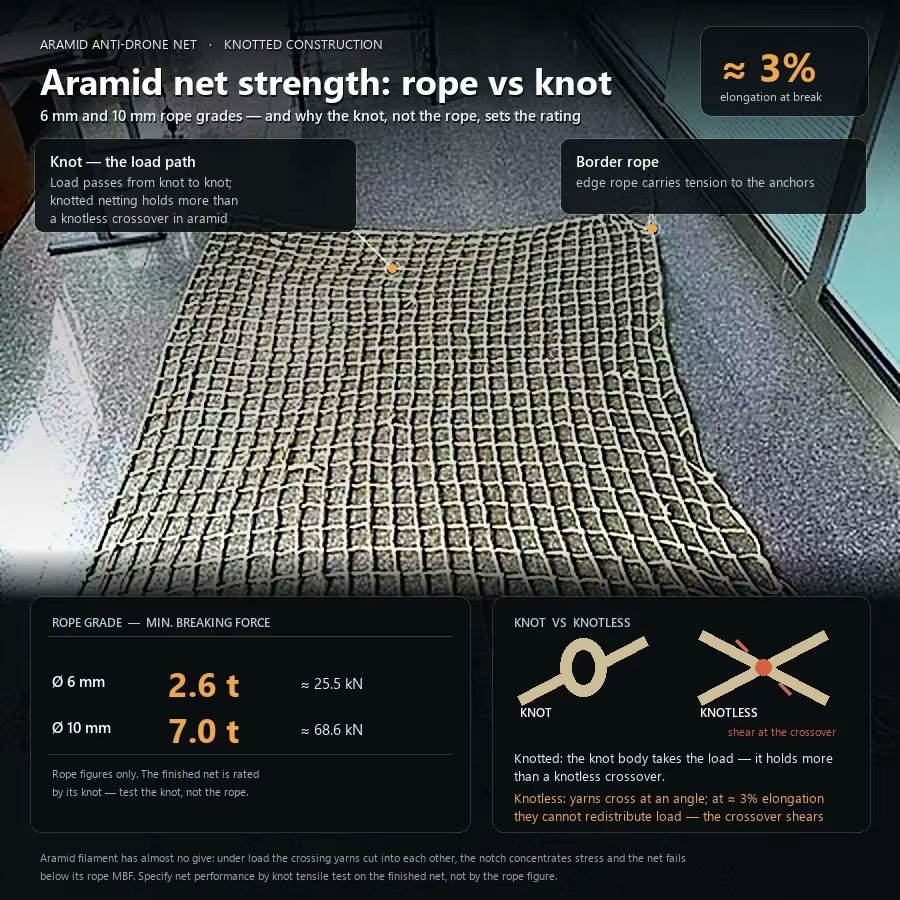
Aramid is the right fibre. A knotless aramid mesh is the wrong structure. Para-aramid elongates only about 3 per cent before it breaks, so there is no stretch in which the yarns can equalise strain. In a knotless (warp-knitted) mesh the yarns interlace at crossovers; load the panel and those crossovers go into shear — filament cuts into filament at the contact point, a notch forms, stress concentrates, and the mesh fails well below the rope’s breaking force. The fibre did not let you down. The crossover did.
A knot converts the same impact into bending through the knot body and tension along the legs, which a braided rope handles well. A 12-strand braid keeps its round section under load instead of flattening into an oval, so the strands share the bend rather than fighting it — the reason braid holds more of its strength through a knot than a twisted rope does.
Steel has no give. The shock arrives at the ferrule undamped, and the ferrule is the least forgiving element in the panel.
Aramid stretches about 3 per cent, then hands the load to the knot and the border rope. Short, but defined — and the panel recovers instead of staying deformed.
Mass. A 10 mm aramid panel at 100 mm mesh weighs about 1.6 kg/m². A wire panel of comparable opening is several times that, which matters when the net has to be lifted onto a roof or a pole line by hand.
Repair. A knot can be re-made on site with a fid and a length of braid. A ferrule needs a press, a die and a new sleeve — and a ferrule remade in the field is a joint nobody can inspect.
Heat and signature. Aramid has no melting point in service: it carbonises from roughly 400 °C and holds its shape, so a drone arriving on fire does not turn the panel into fuel. Being non-metallic, the mesh adds no radar return of its own.
The four columns below are the same comparison an engineer would run before signing a purchase order: what the rope can take, what the node can take, and what that leaves in reserve.
| Crimped 304 wire, 2 mm | Crimped 304 wire, 3.2 mm | Knotted aramid, 6 mm | Knotted aramid, 10 mm | |
|---|---|---|---|---|
| Rope breaking force | 300 kg (2.9 kN) | 700 kg (6.9 kN) | 2,600 kg (25.5 kN) | 7,000 kg (68.6 kN) |
| Node that carries it | Pressed aluminium ferrule | Pressed aluminium ferrule | Hand-set knot, 4 rope ends | Hand-set knot, 4 rope ends |
| Node strength | 140 kg (1.4 kN) | 180–300 kg (1.8–2.9 kN) | about 1.5 t (15 kN)* | about 4.2 t (41 kN)* |
| Node as share of rope | 47 % | 26–43 % | about 60 %* | about 60 %* |
| What ends the test | Rope draws through the sleeve | Rope draws through the sleeve | Rope or knot body | Rope or knot body |
| Repair after a hit | Press, die and new ferrule | Press, die and new ferrule | Re-knot on site | Re-knot on site |
A net quoted on rope strength alone is quoted on the one number that rarely governs. Ask for these instead:
A knot tensile or pull-out report on the finished panel — not the rope certificate.
Aperture against the widest part that would arrive first: the propeller disc, or the leading edge of a fixed wing.
Border rope size and the anchors it terminates into; a panel that is strong enough and tied to undersized posts fails at the posts.
Stand-off — the clear space behind the panel for a caught aircraft to deform into.
Batch traceability for the braid, and a spare length of braid for field repairs.
Doesn’t the knot weaken the rope? Yes, as every knot does, and we quote it that way rather than pretending otherwise. A 6 mm knot at about 60 per cent efficiency still holds roughly five times what a 2 mm crimped ferrule does, and a 10 mm knot roughly fourteen times.
Can a 6 mm net really stop a drone? Look at the energy, not the diameter. A 0.9 kg quadcopter at 20 m/s arrives with about 18 kg·m/s of momentum and 180 J of energy; the panel has to take that away over the 100 mm or so of sag a taut net allows. What governs the outcome is the aperture, the node, the border and the anchors — which is why we quote a panel per opening rather than against a blanket capacity.
Can we simply go up a size in wire rope? You can, and the ferrule stays at 26–47 per cent of the rope, so the joint grows too — but weight grows faster than node strength, and the panel becomes harder to install and slower to repair.
Both builds leave our works with a certificate and a marked batch. Only one of them lets your maintenance team walk the perimeter, find a damaged node and re-make it by hand before the next flight. For perimeter screening and light nuisance traffic a polyester panel does the job at a lower cost per square metre; where a real kinetic impact has to be stopped, the knotted aramid panel is the build that keeps its strength at the point of impact.
The full panel range — apertures, border details, corner eyes and anchor kits — is on the high strength anti drone net page, with the military build set out under Aramid Kevlar anti-drone nets for military & defence and the lower-cost option under drone anti-collision net. The braid itself is described on Kevlar aramid rope, and the wider range sits under safety rope nets.
Send the opening size, the largest drone you expect to meet and the anchor arrangement, and we will come back with a panel specification, a knot test figure and a delivered price. China Lifute Sling Group — telephone +86 523-869 35818, e-mail cnlift@126.com, WhatsApp +86 180 6600 2268, Taizhou City, Jiangsu Province, China.
Company:China Lifute Sling Group
Contact:Mss Wang
Tel:+8613365203036
Mobile:+8613365203036
E-mail:cnlift@126.com
Address:TaiZhou City, JiangSu Province, Lifute District ,China