语言选择: 


Steel is not the problem. The pressed aluminium sleeve is — and a 10 × 20 m opening repeats that sleeve about twenty thousand times.
When a project team starts looking for a drone barrier, the requirement usually leaves the building looking like this: “304 stainless wire rope, 2 mm, 50 mm mesh, 10 × 20 m, delivered to site.” It reads like a specification. In fact it is a material order, because it names the rope and skips the one element that decides whether the panel holds.
On a wire rope net every mesh crossing is a joint: two ropes and one pressed aluminium ferrule. Whatever the rope can do on a straight pull, the finished panel never does, because the load cannot get past the ferrule intact. That, in one sentence, is why we do not offer a high strength anti drone net in steel wire.
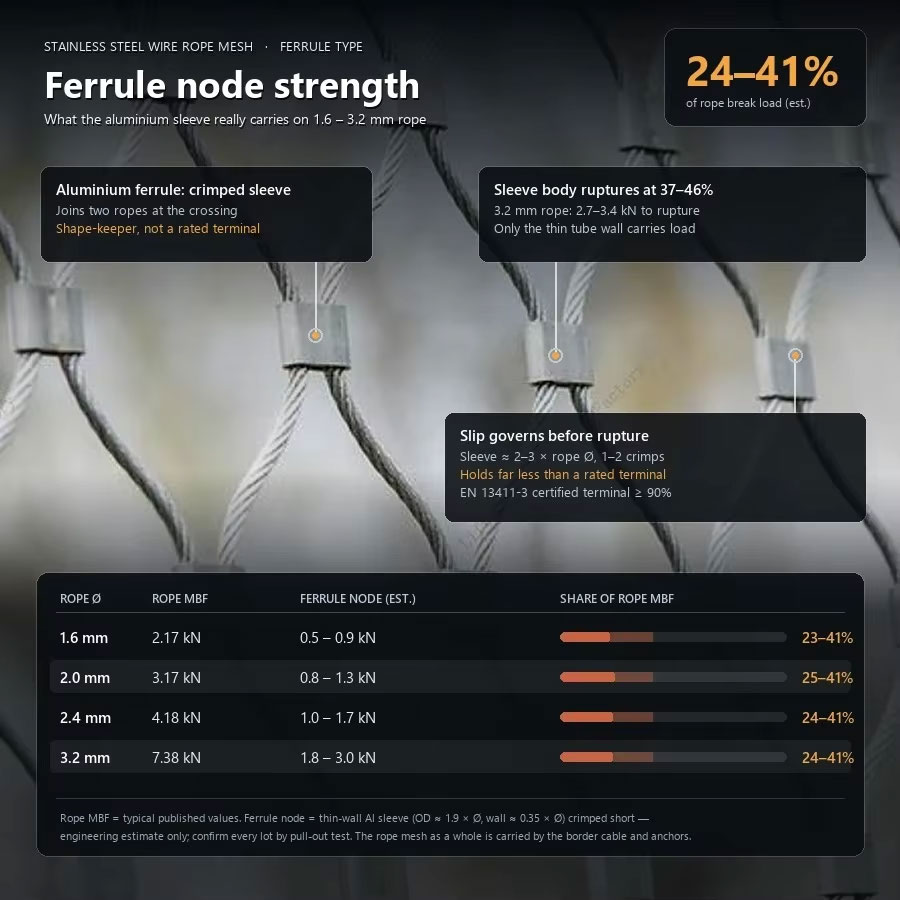
| Rope Ø | Rope MBF | Ferrule node (est.) | Node as share of rope |
|---|---|---|---|
| 1.6 mm | 2.17 kN | 0.5 – 0.9 kN | 23 – 41 % |
| 2.0 mm | 3.17 kN | 0.8 – 1.3 kN | 25 – 41 % |
| 2.4 mm | 4.18 kN | 1.0 – 1.7 kN | 24 – 41 % |
| 3.2 mm | 7.38 kN | 1.8 – 3.0 kN | 24 – 41 % |
Table 1 — rope break load against the pressed joint that has to carry it
Three details on that chart matter more than the percentage itself.
The sleeve is a shape-keeper, not a terminal. It locates two ropes at the crossing and holds them there. It is not a rated termination. A certified ferrule-secured terminal to EN 13411-3 is required to hold at least 90 % of the rope’s breaking force; the crimped mesh ferrule is nowhere near that band, and no press on site will make it one.
Slip governs before rupture. In our own press trials the sleeve body ruptures at 37–46 % of the rope figure — but the test usually ends earlier, when the rope draws through the sleeve. The sleeve is two to three rope diameters long and takes one or two crimps, so only the thin tube wall is doing the gripping: friction and tube stiffness set the number, not the wire.
Nothing scales. Going from 1.6 mm to 3.2 mm doubles the rope’s break load, and the joint stays in the same 24–41 % band. Heavier rope buys a heavier net, not a stronger node — and on a 3.2 mm net the joint may rupture anywhere between 2.7 and 3.4 kN, less than half of what the label promises.
A 10 m × 20 m panel on a 100 mm mesh has about 100 legs across and 200 along: roughly 20,000 crossings, and therefore about 20,000 pressed joints. An arriving aircraft does not load the panel uniformly. It loads the one node it touches first, in milliseconds.
That is what a strength table hides. A panel is not a rope; it is a population of joints, and its behaviour is set by the weakest one inside the impact zone. A wire mesh does have redundancy, which is why a steel net will often catch a small drone. But the way it fails is a slipped ferrule, and a slipped ferrule is invisible: the sleeve looks identical before and after, the rope is no longer gripped, and the mesh sags at one crossing until the next impact finishes the job.
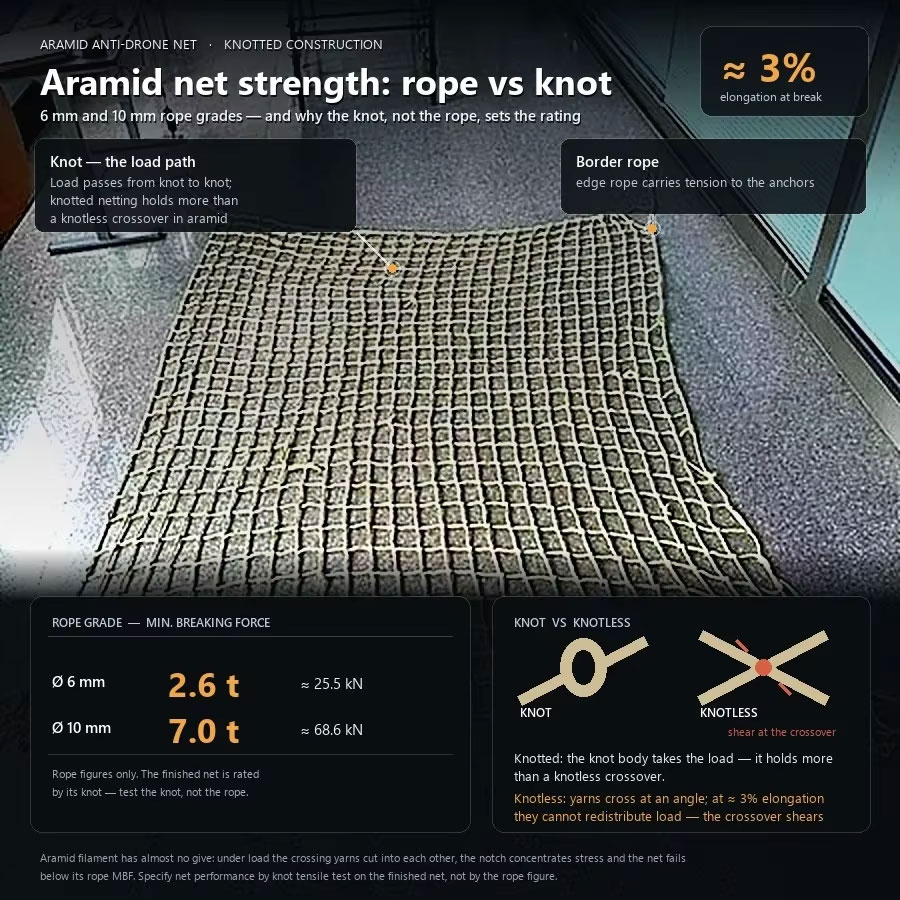
Read the two charts together and the difference stops being about material and becomes about structure.
A knot gathers four rope ends. Load arriving along one leg passes through the curvature of the knot body and leaves through the other three; it is never gripped by a device that can slip, and rope never runs against rope through a pinch point. That is why a knotted panel is specified at roughly four times the joint strength of the same rope in a clamp, and why a 10 mm knot is calculated in the tonne class while a 3.2 mm ferrule is still quoted in kilograms.
The same chart carries the caution we insist on. Aramid has almost no give: at about 3 % elongation the crossing yarns of a knotless mesh cut into each other, the notch concentrates stress, and the net fails below its rope breaking force. The knot is what turns an impact into bending through the knot body and tension along the legs — which is why the specification has to name the construction and not only the fibre. A finished net is proved by a knot tensile test on the panel, never by the rope certificate alone.
These are the reasons a project regrets the wire net six months after handover rather than on the day of the quotation.
1. Mass against access. A knotted 10 mm aramid panel at 100 mm mesh is about 1.6 kg/m²; a wire mesh sized to the same duty runs several times that, and it has to be lifted onto a roof, a pole line or a gantry by hand. Every kilogram is installation labour, and every installation is a working-at-height event.
2. Corrosion inside the sleeve. Stainless wire in a crimped aluminium sleeve is a crevice with two dissimilar metals in it, permanently wet in coastal or industrial air. The visible mesh can look perfect while the wire inside the ferrule has thinned — and the ferrule is exactly the part nobody can inspect without cutting the net.
3. Repair needs a press. A damaged knot is re-made on site with a length of braid and a fid, and the repair is visible and can be recorded. A ferrule needs a press, a die and a new sleeve; a ferrule closed in the field is a joint with no test behind it, on a barrier whose entire argument was joint strength.
4. Metal in the airspace. A steel mesh returns radar and can clutter or shadow the sensors a counter-UAS design depends on. A non-metallic aramid panel adds no return of its own, which matters when the net is one layer of a layered detection scheme rather than the whole of it.
We would rather say this plainly than sell against it. A steel wire net is a reasonable choice when:
the duty is screening, not interception — debris, birds, contraband, a visible deterrent, where no kinetic impact is expected;
the panel is small and static, so node strength never approaches its limit;
resistance to a sharp edge or a tool matters more than mass;
the site is budget-bound and temporary, and the net will be replaced rather than inspected for a decade.
General-purpose bird and debris screening is exactly that job, and our anti drone net for lighter screening duty is specified for it. The moment the requirement becomes “stop an aircraft”, the governing element moves from the rope to the joint — and the joint is where steel wire rope stops being competitive.
If the barrier is meant to be intercepted, six lines replace the whole material order:
| # | The line | What it fixes |
|---|---|---|
| 1 | Knot pull-out figure on the finished panel | The number that actually governs |
| 2 | Aperture against the propeller disc or leading edge | Whether the aircraft is caught at all |
| 3 | Border rope size and splice detail | Where the mesh load leaves the panel |
| 4 | Anchor type and spacing, 2 m or closer | Whether the panel stays up |
| 5 | Stand-off clear behind the panel | Whether a caught aircraft reaches the asset |
| 6 | Batch traceability plus a spare length of braid | Whether the net can be kept in service |
Table 2 — the six lines that replace “2 mm stainless, 50 mm mesh”
On a knotted aramid build these are answered from one drawing: a 12-strand braid with no core — 6 mm at 2.6 t, 10 mm at 7 t — knotted so four ends share every node, bordered with a spliced (never knotted) rope, and delivered with the knot test for the batch supplied. The panel range, apertures and fixing details are on the high strength anti drone net page; the heavier defence build sits under high strength aramid drone defense rope net, the fire case under fireproof aramid flat belt safety net, and the selection logic is set out in how to choose a drone anti-collision net.
Where perimeter work expects no direct hit, the lighter panel is described under drone safety net; where the build has to be engineered against a fast body rather than a hobby quadcopter, drone anti-collision net sets out the aperture and border options. The braid itself is described on aramid rope, and the wider range sits under safety rope nets.
We cannot choose the anti-drone steel wire rope net for interception duty because it is a rope sold with a joint problem: the rope is rated, the ferrule is not, and the ferrule is what the aircraft meets — 24–41 % of the rope figure, repeated about twenty thousand times across a standard opening, with a failure you cannot see and cannot repair on site.
Steel is not a bad material; it is simply the wrong place to put the load path. Where the panel has to take a hit, the load should pass through a knot, into a spliced border, and out to anchors that were sized for it — and the number on the quotation should be the knot, not the reel.
Figures: rope break loads are typical published values for the grades shown; ferrule node values are engineering estimates on the sleeve geometry described and are confirmed per lot by pull-out test. Panel capacity belongs to the whole assembly — panel, knot, border, anchors and stand-off — and is confirmed on the approval drawing.
Company:China Lifute Sling Group
Contact:Mss Wang
Tel:+8613365203036
Mobile:+8613365203036
E-mail:cnlift@126.com
Address:TaiZhou City, JiangSu Province, Lifute District ,China