语言选择: 


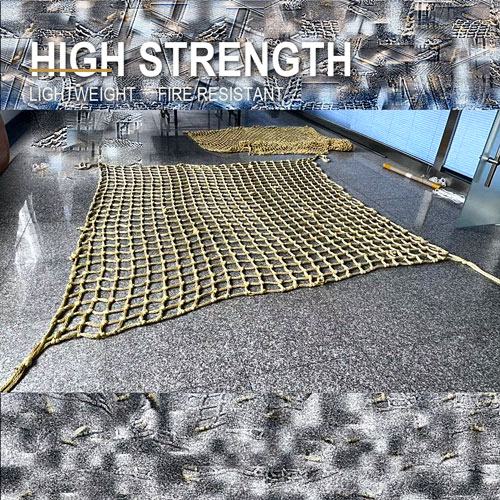
China Lifute Sling Group manufacture Drone Anti-collision Net,Aramid Kevlar Drone Anti-collision Net.
China Lifute Sling Group manufactures drone anti-collision nets in para-aramid (Kevlar®-grade) fibre — a rope net barrier built to take the hit so your asset never has to. Mounted across a window, a substation bay, an apron edge or a perimeter line, the net intercepts an incoming UAV, absorbs the kinetic energy of the impact across the whole mesh rather than at a single point, and drops the airframe inside a controlled footprint.
The net is made in two stages: the rope is precision-braided first, then the net is hand-knotted from that rope. Every load path therefore runs knot → straight rope segment → knot. That detail is what separates a net that absorbs a collision from a net that shreds itself on the first one. Aperture, rope diameter, panel size and border finish are all made to order.
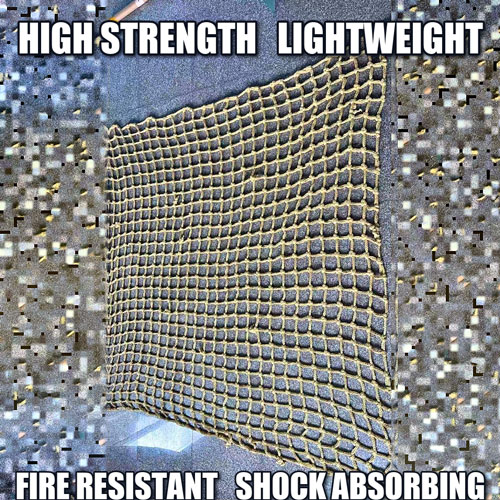
A drone does not need to be destroyed to be stopped — it needs to be denied the last few metres. An anti-collision net works on three levels at once:
This is the difference between an anti-collision net and a plain barrier. A barrier is judged on whether it is still there afterwards. An anti-collision net is judged on whether it is still there and still rated after the third or fourth strike.
| Property | Para-aramid rope net | Why it matters against a drone |
|---|---|---|
| Tensile strength | Very high for its weight — a lighter net carries the same rated load | Less weight on the anchor points and the host structure |
| Cut / abrasion resistance | High; the fibre resists slicing where a prop or a blade contacts the rope | The rope survives repeated propeller strikes instead of fraying |
| Elongation at break | Low (approx. 2.4% – 3.6%) | The mesh does not balloon or sag away from the protected face under wind or impact |
| Heat resistance | High continuous service temperature [确认] | Survives hot facades, plant rooms and solar-exposed elevations |
| Chemical resistance | Excellent against oils, fuels and most organic solvents | Suitable for industrial and transport environments |
| UV / weathering | Good; UV-stabilised coating available | Permanent outdoor installations keep their rating |
The low elongation is a genuine trade-off you should understand before you specify. It is the reason the net keeps its shape and does not creep, but it is also the reason ordinary rope-making methods ruin aramid: filaments that barely stretch will grind and shear each other wherever they cross under load.
This is the part of the specification that decides how much of your aramid actually ends up working.
The aramid filaments are laid in parallel-helical paths by braiding, not twisting. The filaments stay aligned and are not forced to cut across one another at every turn, so the rope keeps the fibre's strength instead of spending it on internal abrasion.
The braided rope is hand-knotted into the panel, so the knots become deliberate structural node points. Load travels through straight rope segments between knots instead of through friction contact zones. The mesh stays uniform, and a damaged section can be cut out and re-knotted on site.
Everything below is made to order — the table is a starting point for the specification sheet, not a stock list. Send us the span, the drone classes and the fixing method and we will confirm the panel drawing.
| Item | Range / standard |
|---|---|
| Material | 100% para-aramid fibre (Kevlar® 29 grade or equivalent) |
| Rope construction | Precision-braided, non-twisted |
| Rope diameter | 4 mm / 6 mm / 8 mm / 10 mm / 12 mm |
| Mesh aperture | 20 mm – 200 mm, custom; standard 50 / 100 / 150 mm |
| Net assembly | Hand-knotted, tension-set knots |
| Panel size | Made to order; large perimeters supplied as seamless joined panels |
| Edge finishing | Reinforced border rope with stainless steel or galvanised eyelets |
| Elongation at break | Approx. 2.4% – 3.6% [确认] |
| Colour | Natural aramid yellow; other colours on request [确认] |
| Installation hardware | Optional: tensioning cables, turnbuckles, anchor plates, quick-release pins |
| Reference weight | Approx. 12 – 18 kg per 100 m² (6 mm rope, 100 mm mesh) [确认] |
Twisted rope and knotless mesh structures make aramid fibres cut into each other wherever they bear on one another. The loss is not cosmetic — it is capacity you paid for and cannot use. Braiding first and knotting second keeps the load path straight so the fibre's rated strength stays available for the job you bought it for: absorbing the collision.
When a knotted aramid net finally reaches its limit, it fails at identifiable points — a knot or a rope segment breaks where you can see it. Knotless structures hide internal abrasion until they let go. For a permanent barrier that has to be signed off after every incident, being able to inspect the net and record its condition is worth as much as the headline strength figure.
A damaged panel is cut out and re-knotted with spare braided rope, on site, with hand tools. There is no factory return and no need to take the whole elevation out of service.
A rope mesh is largely transparent. On a glazed façade or in front of a stadium screen it blocks far less light and sightline than a solid barrier, and it presents very little solid area to the wind, which keeps the load on the frame and anchors manageable.
We build to the installation, not to a catalogue number. The information we need from you to quote and draw the panel:
Panels are supplied with a reinforced border rope and eyelets, folded and bagged for transport, with panel drawings for the installation team. OEM and private-label supply are both available — see our company profile for factory capacity and certifications, or read which company manufactures webbing slings for how we handle OEM programmes.
For questions about terms, lead time and shipping, see our notes on how much a sling costs and where you can buy webbing slings, or simply send us the requirement.
It is a high-strength rope net barrier installed in front of or around an asset so that an incoming drone strikes the mesh instead of the asset. The net absorbs the kinetic energy of the impact, entangles the rotors, and brings the drone down inside a controlled footprint.
Aramid fibre has very low elongation, so twisted rope and knotless mesh make the filaments grind against each other at every contact point, which can cost a significant share of the fibre's rated strength. We braid the rope first, then hand-knot the net, so every load path runs knot to straight rope segment to knot.
Mesh aperture is matched to the smallest drone you need to stop. Smaller apertures such as 50 mm stop small consumer and FPV drones but add weight and wind load; larger apertures such as 100 mm or 150 mm reduce weight and cost and are used where only larger UAVs are a concern. We supply 20 mm to 200 mm apertures and will recommend one once you tell us the drone classes and the span.
Yes. Panels are made to order and large perimeters are supplied as seamless joined panels rather than many small sheets, so there are no weak intermediate seams on the protected face.
Para-aramid has good UV resistance and excellent resistance to oils, fuels and most organic solvents. For permanent outdoor installations we recommend the optional UV-stabilised coating and a marine-grade border rope, and we will confirm the expected service interval for your climate.
The standard edge finish is a reinforced border rope with stainless steel or galvanised eyelets at a spacing agreed with you. From there the panel is tensioned with steel cables, turnbuckles and anchor plates, or fixed to a steel frame. Tensioning hardware is optional and can be quoted with the net.
Yes. Because the net is knotted, a damaged section can be cut out and re-knotted on site with spare braided rope. No factory return and no special equipment are needed.
Send us the span, the mesh aperture you have in mind and the fixing method, and we will come back with a panel drawing, a rope diameter recommendation and a quotation. If you are still at the concept stage, tell us the asset and the drone classes and we will propose a specification.
Order online | Contact us | Send an enquiry
China Lifute Sling Group — Contact: Mss Wang | Tel / WhatsApp: +8613365203036 | E-mail: cnlift@126.com | Address: TaiZhou City, JiangSu Province, Lifute District, China
Further reading: company profile, company culture, downloads, help documents, how much a sling costs, where to buy webbing slings.