


Why Knotted Aramid is Replacing Steel Wire Mesh in High-Velocity UAV Defense: A Structural Mechanics Analysis
Category: Defense Technology & Perimeter Security | Keywords: Aramid knotted Anti Drone net, Kevlar UAV Barrier
Executive Synopsis: In perimeter defense against high-kinetic FPV and commercial drone incursions, physical containment structures face unprecedented dynamic loads. Two structural vulnerabilities have historically compromised field installations: the cold-pressed aluminum ferrule failure bottleneck in stainless steel wire mesh (DIN EN 13411-3), and microscopic inter-filament self-shearing in knotless Kevlar netting. Recent ballistics and certified tensile testing reveal that mechanically locked Aramid knotted Anti Drone net systems eliminate inter-filament friction degradation, delivering certified breaking loads up to 70.67 kN (7.07 metric tons) in 10mm specifications while reducing deadweight by over 78% compared to traditional wire rope barriers.
1. The Modern Airspace Threat: 3D Kinetic Incursions at Critical Facilities
The global proliferation of low-cost, agile, and high-velocity uncrewed aerial systems (UAS) has fundamentally transformed perimeter security. Critical facilities—including electrical transformer substations, petrochemical refineries, data centers, government complexes, logistics depots, and forward operating bases—are no longer solely protected by traditional two-dimensional ground barriers.
When a 2 to 8 kg drone carrying potential incendiary or explosive payloads strikes a containment barrier at velocities exceeding 100 to 140 km/h, the impact delivers immense concentrated dynamic energy over milliseconds. Unlike static loads, this dynamic impulse forces perimeter materials to absorb rapid elastic deformation. Under these extreme localized conditions, conventional steel wire mesh and knotless synthetic nets suffer predictable, catastrophic structural failures.
2. Deconstructing Conventional Failures: Why Wire Rope and Knotless Nets Collapse
A. The Aluminum Ferrule Failure Bottleneck in Stainless Steel Wire Mesh
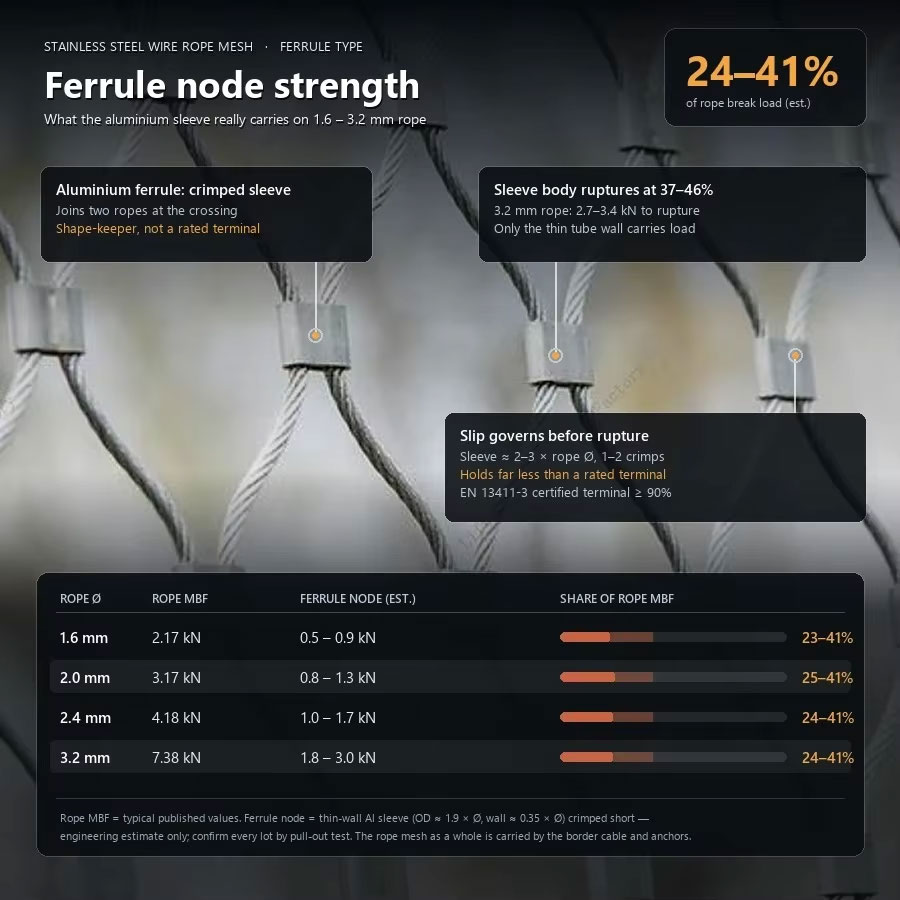
Stainless steel wire rope has long been utilized for containment barriers. In architectural and security applications, crossing cables are swaged together using cold-pressed aluminum sleeves (ferrules) manufactured according to DIN EN 13411-3. While the wire rope itself possesses high axial strength, the aluminum ferrule joints represent a critical structural weak link under dynamic projectile impact:
| Wire Rope Dia. (mm) | Theoretical Wire Rope Breaking Force | DIN EN 13411-3 Aluminum Sleeve Limit | Failure Mechanism |
|---|---|---|---|
| 3.0 mm | 500 kgf (4.9 kN) | 5.4 kN (~552 kgf) | Balanced under low tension |
| 4.0 mm | 900 kgf (8.8 kN) | 9.6 kN (~981 kgf) | Balanced under low tension |
| 6.0 mm | 2.00 Metric Tons (19.6 kN) | 1.40 Metric Tons (13.7 kN) | Sleeve slips & shears prematurely (-30%) |
| 10.0 mm | 5.20 Metric Tons (51.0 kN) | 3.90 Metric Tons (38.2 kN) | Sleeve fails at 75% of cable strength |
Under dynamic shock loads, the ductile aluminum sleeve deforms and micro-cracks, causing the steel wire strands to pull through at values far below nominal rope capacity. Furthermore, stainless steel wire mesh carries an immense deadweight penalty (>5.6 kg/m²), creates electrical conductivity hazards, and produces severe radar reflections that blind early-warning detection sensors.
B. The Inter-Filament Micro-Sawing Effect in Knotless Aramid Netting
Para-Aramid (Kevlar®) exhibits near-zero elongation (<2.5%) and ultra-high tensile modulus. When facility planners attempt to utilize knotless (raschel-knitted or woven) aramid netting to save weight, they trigger a catastrophic micro-mechanical failure mechanism.
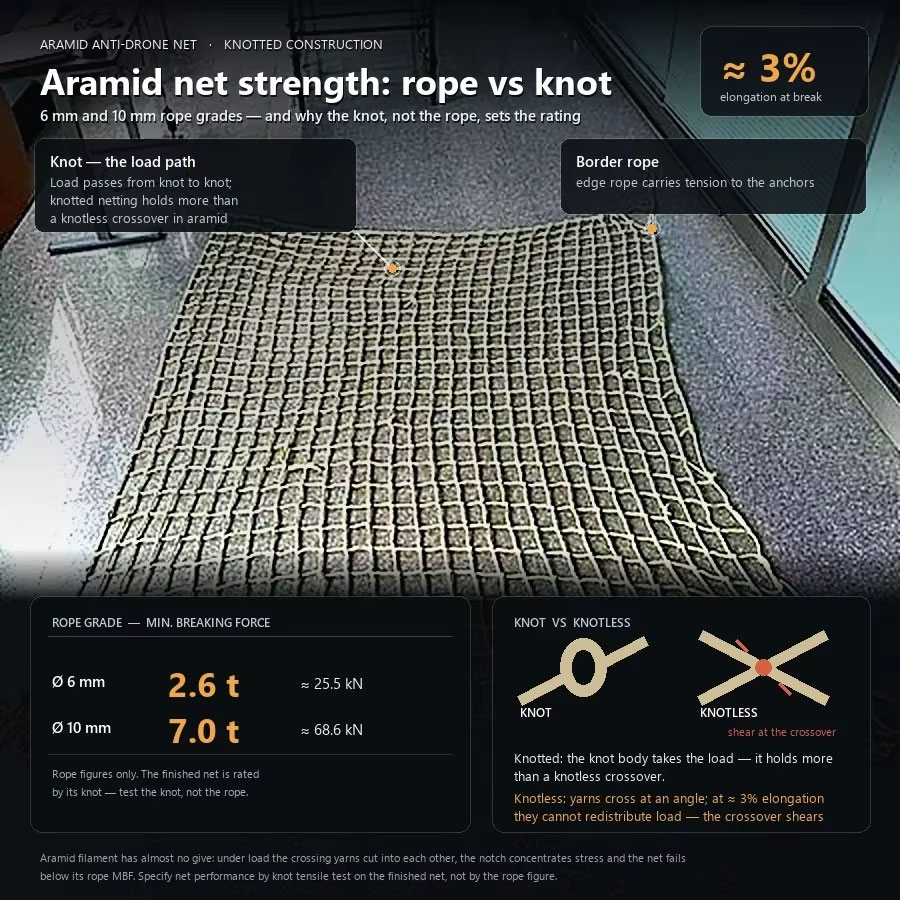
In a knotless weave, warp and weft yarns overlap without mechanical locking. When a high-velocity drone strikes a knotless mesh aperture, the sudden displacement forces intersecting aramid filaments across each other under extreme tension. Because aramid macromolecules possess rigid crystalline alignment, the abrasive sliding generates intense transverse friction—acting like high-speed microscopic saws. This micro-sawing effect rapidly shears the load-bearing filaments internally, causing the net to lose 60% to 75% of its tensile capacity at the exact point of impact.
3. The Engineering Breakthrough: Mechanically Locked Knotted Aramid Netting
To eliminate both the ferrule bottleneck of steel wire mesh and the abrasive shear degradation of knotless weaves, specialized engineering manufacturers developed the Aramid knotted Anti Drone net.
By fabricating the defense barrier from continuous-filament braided Para-Aramid ropes joined by precision, high-tension mechanical knots, each aperture is isolated into an independent energy-absorption cell:
Zero Tensile Loss: Locked mechanical knots prevent relative filament displacement. Impact tension is transmitted purely along the longitudinal axis of the braided ropes, preserving 100% of the aramid fiber's inherent breaking strength.
Certified Ballistic Tensile Capacity: In official universal tensile pull testing (Sample Dia10mm, Test Report No. 26101406), 10.0mm braided aramid knotted rope achieved an exceptional maximum breaking force of Fm = 70.67 kN (7.07 Metric Tons). For 6.0mm braided aramid rope, the single-strand breaking capacity reaches 2.60 Metric Tons (25.5 kN).
| Engineering Property | Stainless Steel Ferruled Wire Mesh | Aramid Knotted Anti Drone Net | Tactical & Structural Advantage |
|---|---|---|---|
| 6.0 mm Joint Breaking Load | 1.40 Tons (Aluminum ferrule slips) | 2.60 Tons (25.5 kN continuous) | +85.7% Higher Breaking Strength |
| 10.0 mm Joint Breaking Load | 3.90 Tons (Aluminum ferrule shears) | 7.07 Tons (70.67 kN Certified) | +81.2% Higher Breaking Strength |
| Areal Deadweight Burden | 5.20 – 6.80 kg/m² | 1.10 – 1.25 kg/m² | 78.9% Reduction in Deadload |
| Radar & RF Compatibility | Conductive; distorts active radar | 100% Dielectric; non-conductive | Zero Radar/RF Distortion |
4. Tactical Advantages in Perimeter & Critical Infrastructure Deployment
Beyond sheer kinetic resistance, the knotted aramid barrier system delivers operational benefits that resolve major engineering constraints:
Instant Propeller Entanglement: When high-RPM carbon-fiber drone rotors contact the flexible aramid strands, the net immediately wraps around rotor hubs and motor shafts, stalling the motors within milliseconds and neutralizing the threat without hazardous shrapnel scattering.
Massive Structural & Installation Cost Savings: Because knotted aramid netting is nearly 80% lighter than stainless steel mesh, it can be suspended from lightweight aluminum masts, tensioned catenary cables, or retrofitted onto existing perimeter fencing without requiring massive concrete footings or reinforced structural frames.
Extreme Environmental Resilience: Para-Aramid is inherently flame retardant (LOI > 28%, degradation temperature > 450°C, zero melt-drip behavior) and is completely immune to marine salt spray, acid rain, and UV degradation when treated with specialized protective coatings.
Comprehensive Defense Array Integration: Engineers designing multi-tier perimeter security can integrate these barriers alongside broader safety rope net arrays, evaluate high-temperature and cut-resistant requirements via para aramid safety net specifications, and reference specialized technical standards on the dedicated knotted anti drone net technical hub.
5. Engineering Selection & Procurement Guidelines
When specifying passive physical interception barriers for defense and critical infrastructure projects, security architects should apply the following threat-matched criteria:
Light Commercial Drone Threat (0.5 to 2.5 kg at <90 km/h): Specify 4.0mm to 6.0mm Aramid Knotted Netting with 50x50 mm to 100x100 mm mesh pitch. Provides 25.5 kN single-rope breaking force while maintaining high optical transparency.
Tactical FPV & Heavy Loitering Munitions (3.0 to 10.0+ kg at >120 km/h): Specify 10.0mm Aramid Knotted Netting with 100x100 mm to 200x200 mm mesh pitch. Provides certified 70.67 kN (7.07 Metric Tons) kinetic breaking capacity to ensure complete containment.
Rigorous Quality Verification: Never accept unverified knotless synthetic nets or ferruled wire rope without certified universal pull test documentation demonstrating joint survivability under dynamic shock loads.