50mm Cargo Lashing Belt Ratchet Straps — Heavy-Duty Tie-Down Straps for Transportation
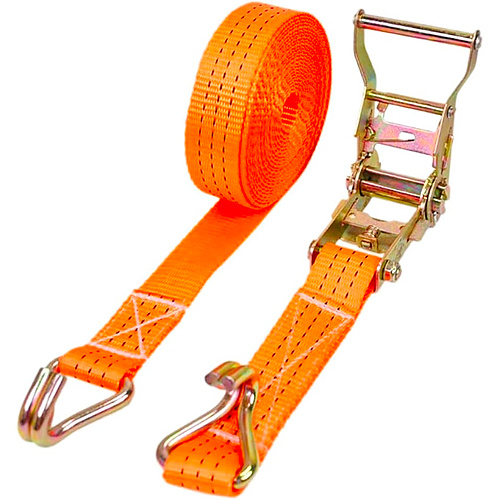
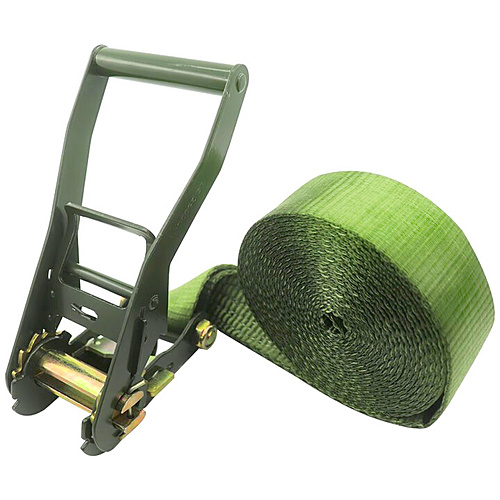
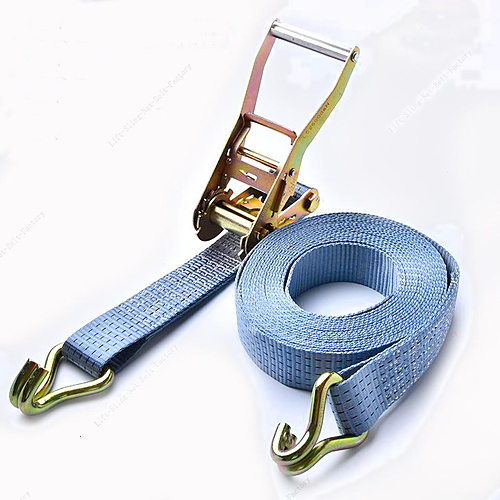
China Lifute Sling Group manufactures 50 mm cargo lashing belt ratchet straps for road transport, container work and heavy equipment haulage. The 50 mm high-tenacity polyester belt is rated at a 5,000 daN lashing capacity (LC) with a 10,000 daN minimum breaking force, tensioned by a 50 mm zinc-plated ratchet buckle and finished with double J-hooks, D-rings, flat hooks — or no fittings at all. Every heavy-duty tie-down strap is labelled to EN 12195-2 with its LC, STF, length and batch number, and verified against our in-house tensile test records.
If you are securing steel plate on a flatbed, palletised freight in a curtain-side trailer, machinery on a low-bed or a container load on a terminal, a 50 mm cargo lashing belt is the size that does the work. It is the one width that combines a genuinely heavy lashing capacity with a belt a single operator can throw over a load and tension by hand in under a minute.
At a glance
Lashing capacity: 5,000 daN (≈5.0 t) · MBF: 10,000 daN (≈10.2 t) · safety factor 2:1
Webbing: 50 mm high-tenacity polyester (PES), UV-stabilised
Pre-tension: STF 350 daN at ≤500 N handle force
End fittings: double J-hook · D-ring · flat hook · S-hook · endless
Length: 2–20 m, standard 4 / 6 / 8 / 10 / 12 m
Standard: EN 12195-2; WSTDA T-4 and AS/NZS 4380 on request
On this page
Why 50 mm is the working size for road freight
Lashing strap widths run from 25 mm to 100 mm. The 25 mm and 35 mm belts are for light vans, motorcycles and small plant; the 75 mm and 100 mm belts are for abnormal loads and heavy steel. The 50 mm cargo lashing belt sits in the middle, and that is exactly why it accounts for most of the volume we ship.
It covers the mainstream load. A 5,000 daN lashing capacity handles the great majority of flatbed, curtain-side, container and low-bed work without moving up to a 75 mm assembly that weighs and costs considerably more.
It spreads the load. A 50 mm belt gives roughly four times the bearing area of a 25 mm belt, so it does not crush cartons, mark painted steel or cut into timber edges.
One person can tension it. A 285 mm ratchet handle reaches 350 daN of pre-tension at under 500 N of hand force — comfortable for a single operator, with no tensioner or tooling.
It matches the hardware you already have. 50 mm buckles, J-hooks, flat hooks and D-rings are the standard interchangeable family across Europe and North America, so replacements and spares are never a sourcing problem.
It is the best cost per tonne secured. Going from 50 mm to 75 mm buys roughly 50% more LC for a much larger increase in belt weight, buckle size and price.
Technical parameters
The table below is the production specification for the standard 50 mm heavy-duty ratchet lashing strap. Non-standard capacities, widths and fitting combinations are built to order against your drawing.
| Parameter | Specification |
|---|---|
| Product type | 50 mm (2 in) cargo lashing belt / ratchet tie-down strap assembly |
| Webbing width | 50 mm nominal (±1 mm) |
| Webbing material | High-tenacity polyester (PES), UV-stabilised, 2-ply woven |
| Lashing capacity, LC | 5,000 daN (≈5.0 t) |
| Minimum breaking force, MBF | 10,000 daN (≈10.2 t) |
| Safety factor | 2:1, as required by EN 12195-2 for load restraint |
| Elongation at LC | ≤7% |
| Standard tension force, STF | 350 daN |
| Handle force at STF | ≤500 N |
| Ratchet buckle | 50 mm pressed-steel housing, zinc-plated, hardened pawl, 285 mm handle |
| End fittings | Double J-hook · D-ring · flat hook · S-hook · endless (no fitting) |
| Standard lengths | 4 / 6 / 8 / 10 / 12 m; 2–20 m to order |
| Colour | Blue, orange, green, grey, black — other colours to order |
| Temperature range | −40 °C to +100 °C |
| Marking | EN 12195-2 label: LC, STF, length, material, batch number, manufacturer |
| Packing | 10 pcs per carton (hook sets); 20 pcs per carton (endless) |
Lashing capacity, STF and how many straps you need
Three numbers decide whether a lashing strap is right for the job, and buyers regularly confuse them. They are not interchangeable.
| Term | What it means | Typical value here |
|---|---|---|
| LC lashing capacity | The maximum force the assembly may restrain in service. This is the number you design the load restraint around. | 5,000 daN (≈5.0 t) |
| MBF minimum breaking force | The force at which the assembly fails in a tensile test. For lashing it is 2 × LC. | 10,000 daN (≈10.2 t) |
| STF standard tension force | The pre-tension the ratchet puts into the belt at the permitted handle force. This is what actually holds the cargo. | 350 daN |
Do not read LC like a lifting capacity. A lashing strap is built to a 2:1 safety factor; a polyester webbing sling is built to 7:1 under EN 1492-1. A 5 t lashing strap and a 5 t lifting sling are not the same article and must never be substituted for one another.
The number of straps follows from a simple balance: the lashing force must cover the inertia of the cargo minus the friction under it.
Required lashing force = (acceleration factor × mass × g) − (friction coefficient × mass × g)
Number of straps = required lashing force ÷ (2 × STF)
Under EN 12195-1 the design acceleration is 0.8 g forward and 0.5 g sideways and rearward. Two worked examples show how quickly the count adds up:
| Cargo | Direction | Friction μ | Residual force | Straps at 350 daN STF |
|---|---|---|---|---|
| 20 t steel plate | Forward, 0.8 g | 0.3 | 98.1 kN | 14 straps (7 pairs) |
| 10 t palletised goods | Sideways, 0.5 g | 0.3 | 19.6 kN | 3 straps (2 pairs) |
Two practical points follow. First, friction is doing more work than most people expect — a 20 t load on timber dunnage with μ ≈ 0.3 needs a third less lashing than the same load on bare steel plate. Second, always round up and always check the anchor points: the strongest strap is limited by the weakest rail, ring or corner casting it is hooked to.
Attachments and end fittings
The webbing sets the capacity; the fittings decide whether the 50 mm cargo lashing belt can actually be attached to your vehicle. Every fitting below is available on the same 50 mm belt, and each one is rated at or above the 10,000 daN breaking force of the webbing — a fitting must never become the weak link.
| Fitting | Material and finish | Dimensions | Breaking force |
|---|---|---|---|
| Double J-hook (claw hook) | Forged carbon steel, zinc-plated (gold or silver passivation) | Fits 50 mm webbing; hook opening 26–30 mm, throat ≈30 mm | ≥10,000 daN |
| Flat hook (container / flatbed) | Pressed steel, 4 mm section, zinc-plated | 50 mm body, 45 mm slot for side rails and corner fittings | ≥10,000 daN |
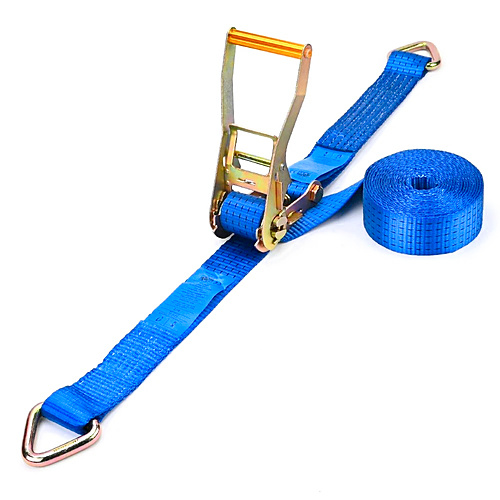
| D-ring / delta ring | Carbon steel wire, zinc-plated | Ø12 mm wire, 50 × 100 mm inner aperture | ≥10,000 daN |
| S-hook | Carbon steel, zinc-plated | Ø12 mm, 50 mm throat | ≥10,000 daN |
| Ratchet buckle | Pressed steel housing 3.0 mm, hardened pawl, riveted pivot, zinc-plated | 50 mm mouth, 285 mm handle, 11 mm spindle | ≥10,000 daN |
| Endless (no fitting) | — | Sewn loop or reinforced eye, 50 mm | ≥10,000 daN |
| Wear sleeve (optional) | PVC-coated polyester, 600 D | 300 mm long, fits 50 mm belt | — |
Which end do I need? Double J-hooks are the general-purpose choice: they clip into lashing rails, recessed D-rings and side pockets, and they release under load without a tool. Flat hooks are for flatbed side rails and container corner fittings, where a J-hook will not seat. D-rings give a closed eye that will not slip off a hook or a bar, which is why they are common on car transporters and machinery decks. Endless belts have no metal at all and are used where the strap passes around the load and back to the ratchet — no scratching, no hook to lose.
Webbing, stitching and the label
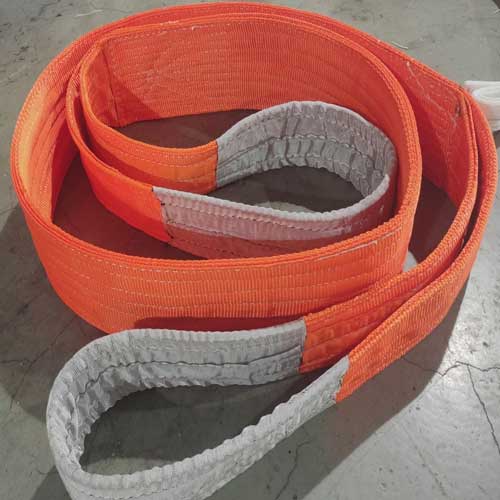
The belt itself is woven from high-tenacity polyester yarn, the same fibre family used across our lifting sling webbing range, chosen for three properties that matter in transport: low elongation, good abrasion resistance and resistance to UV and to most mineral acids.
Weave and thickness. A dense 2-ply weave at 50 mm gives the belt its 10,000 daN breaking force without the bulk of a wider sling. The surface is calendered so it slides over load edges instead of snagging.
Elongation ≤7% at LC. Low stretch keeps the lashing force where you set it. A belt that creeps under load is a belt that comes loose at the third motorway junction.
Stitching. Six-line lock stitch in high-tenacity polyester thread, 8 stitches per 100 mm, with the stitch pattern set back from the belt edge so that edge wear does not attack the seam. Eyes and loops are reinforced where the fitting bears.
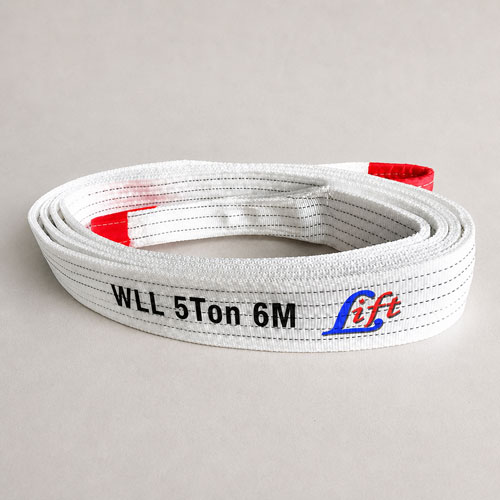
Label. A permanently attached, printed label carries the LC, the STF, the length, the material, the standard reference, the manufacturer and a batch number that ties the strap to its test record. A strap with a missing or illegible label is out of service, however good it looks.
Lengths and configurations
Ratchet straps are supplied in three configurations. On a 5 tonne ratchet strap the configuration is usually more important than the length.
| Configuration | What it is | Best for |
|---|---|---|
| One-piece endless | Belt with a ratchet at one end and a hook at the other; the belt passes around the load and back into the ratchet | General cargo, pallets, bundles, round loads |
| Two-piece, fixed end | Short fixed length with a hook, plus a long adjustable length carrying the ratchet | Flatbed and curtain-side work where one anchor is fixed |
| Three-piece / separate ends | Ratchet plus two separate lashing ends, hooked independently | Over-the-top lashing between two rails or two corner fittings |
Length is measured bearing point to bearing point with the strap laid flat, as EN 12195-2 requires — not the total cut length of the belt. If you are replacing an existing strap, measure the old one the same way, then add 300–500 mm of take-up so the ratchet is not at the end of its travel when the load settles.
Colour and identification
Blue, orange, green, grey and black are all standard, and any colour can be woven to order. It is worth being clear about what colour does and does not mean on a lashing strap.
Colour is not a capacity code on lashing straps. Unlike a lifting sling, where EN 1492-1 ties the webbing colour to the working load limit, EN 12195-2 does not colour-code lashing capacity. On a ratchet strap the label is the authority: read the LC from the label, never from the colour.
Colour is still useful operationally — it lets a fleet standardise on one colour per trailer type, per customer or per inspection cycle, and it makes a damaged strap obvious against a clean load. We print customer names, logos, part numbers and multilingual warnings on the label at no extra tooling cost.
Where 50 mm ratchet straps are used
Flatbed and step-frame trailers — steel plate and sections, timber packs, concrete products, scaffolding.
Curtain-side and box trailers — palletised freight, white goods, packaged machinery.
Container and terminal work — internal load restraint and flat-rack securing with flat hooks.
Low-bed and heavy haulage — plant, excavators, transformers, turbine components.
Car transporters and vehicle logistics — wheel-through lashing with D-ring ends.
Steel coil and tube — coil cradles and bundled tube, usually in pairs with edge protection.
Boat, yacht and event transport — hulls on cradles, truss and staging in road cases.
Warehouse and yard — bundling, rack restraint and storm securing of stacked material.
For loads that need a wider bearing face or a full envelope rather than a single belt — loose brick, roof tiles, bundled tube — pair the lashing straps with a cargo lifting net. For round or abrasive loads where a belt alone would chafe, a round sling or a flat woven webbing sling used as a soft sling under the belt will extend service life considerably.
Standards and compliance
| Standard | Region | Safety factor |
|---|---|---|
| EN 12195-2 | Europe, UK, Middle East, Africa | 2:1 |
| WSTDA T-4 | USA, Canada | 2:1 |
| AS/NZS 4380 | Australia, New Zealand | 2:1 |
| EN 12195-1 | Calculation of lashing forces | — |
We build to EN 12195-2 as standard and to WSTDA T-4 or AS/NZS 4380 on request — name the standard and the marking language on the purchase order, because the label content differs between them. Our quality system is certified to ISO 9001, and batch records are retained so that a label number can be traced back to its webbing lot, its stitching run and its tensile test.
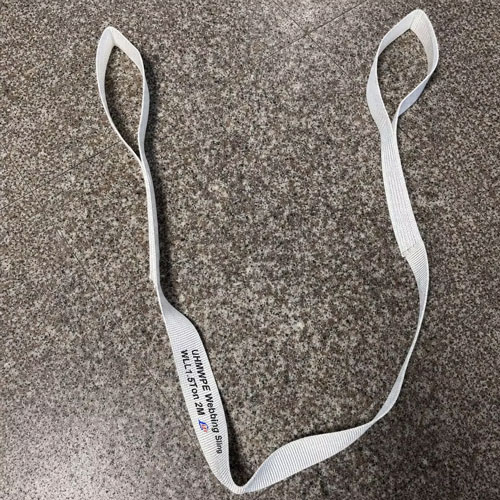
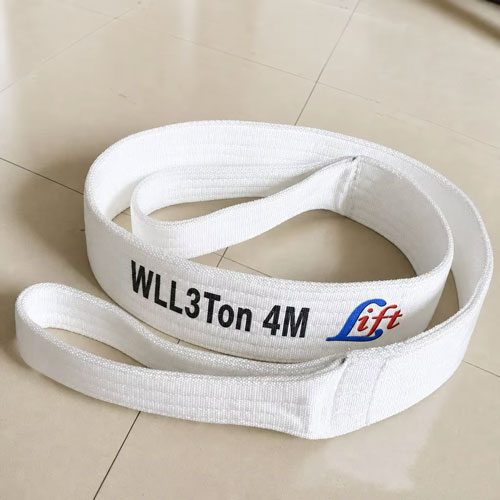
A lashing strap is not a lifting sling. It is designed, marked and tested for load restraint at a 2:1 factor. Using one to lift a load, or using a lifting sling to lash a load, is a misuse that no certificate covers. For lifting duty, choose from our webbing slings, endless lifting slings or UHMWPE webbing slings, all built to a 7:1 factor.
Safe use, inspection and withdrawal
Always
Inspect the strap before each use and again before it goes back in the cab.
Keep the belt flat and untwisted through the buckle — a twisted belt loses a large part of its strength.
Use edge protectors or a wear sleeve wherever the belt crosses a sharp edge, a hot surface or a weld.
Tension to the STF on the label with the handle flat against the housing at the end of the stroke.
Check the anchor points: a rail, ring or corner casting is often the weakest element in the system.
Stow straps dry and out of sunlight; never leave them coiled on a wet deck.
Never
Knot, splice or shorten a lashing strap, and never join two straps to make a longer one.
Exceed the LC, or use the strap as a lifting sling or as a tow rope.
Allow the belt to rub on a sharp edge, exhaust or welding spatter.
Use a strap with a missing label, cut webbing, loose stitching, a bent buckle or a distorted hook.
Release a ratchet under full load with your hand in the path of the handle.
Withdraw from service
On any of the following: illegible or missing label; cuts, tears, burns or abrasion through the weave; loose, broken or pulled stitching; chemical damage or stiffening from UV degradation; a bent, cracked or badly worn buckle, hook or ring; corrosion that has reduced the section of a fitting.
How to order
Give us these eight points and we will quote a task-specific strap rather than a catalogue page:
Lashing capacity required (LC in daN) and the standard — for example EN 12195-2, 5,000 daN
Webbing width and colour
Length, and the configuration: endless, two-piece fixed end, or three-piece
End fittings: double J-hook, flat hook, D-ring, S-hook or endless
Ratchet type: standard or long lever
Quantity, and whether it is a one-off or a repeating programme
Marking: label language, customer logo, part number, barcode
Certification and packing requirements, plus any OEM branding
Request a quote for 50 mm ratchet lashing straps
Send your LC, length, fitting and quantity — we will confirm the specification, the label artwork and the delivery date, usually within one working day.
Contact our sales team · Order online · About the factory
Frequently asked questions
What does 5,000 daN mean on a 50 mm ratchet strap?
daN is deca-newton: 1 daN is about 1.02 kg of force, so 5,000 daN LC is roughly 5.0 tonnes of lashing capacity. The minimum breaking force is twice that — 10,000 daN — because EN 12195-2 requires a 2:1 safety factor for load restraint.
Can a 50 mm ratchet lashing strap be used for lifting?
No. A lashing strap is built and marked to a 2:1 factor for restraining cargo; a lifting sling is built to 7:1 under EN 1492-1. The two are not interchangeable in either direction.
How many 50 mm ratchet straps do I need for a 20 tonne load?
For a 20 t load restrained forward at 0.8 g with a friction coefficient of 0.3, about 98 kN of lashing force remains after friction. At an STF of 350 daN per strap and two straps per tensioned pair, that is roughly 14 straps, or 7 pairs. Confirm the figure against EN 12195-1 for your own load and vehicle.
What is the difference between J-hooks, D-rings and flat hooks?
Double J-hooks clip into recessed anchor points and lashing rails; D-rings give a closed eye for hooks and shackles; flat hooks slide into flatbed side rails and container corner fittings. All three are available on the same belt at the same 10,000 daN breaking force.
What lengths can you supply?
Standard lengths are 4, 6, 8, 10 and 12 m, and we build 2–20 m to order. Length is measured bearing point to bearing point with the strap laid flat, as EN 12195-2 requires.
Do you supply test certificates and OEM labels?
Yes. Every batch is verified on our in-house 100-tonne horizontal tensile machine and supplied with a batch test record. Customer labels, logos and multilingual markings are printed on request.
Can I get the same strap in a different colour for fleet coding?
Yes — blue, orange, green, grey and black are held as standard and other colours can be woven to order. Remember that on a lashing strap the colour is a fleet convention, not a capacity code; the LC is on the label.
About China Lifute Sling Group
China Lifute Sling Group manufactures ratchet lashing straps, webbing slings, endless slings, round slings, cargo lifting nets, nylon rope and rigging from the TaiZhou Lift Sling Net Belt Factory in Gaogang District, TaiZhou, Jiangsu Province. The works has been producing slings since 1980 and has been a registered manufacturer since 2002.
Weaving, stitching and finished assembly carried out in-house across more than 10,000 m² of workshops, with 86 production staff.
In-house verification on a fibre testing instrument, a rope-and-belt tensile machine and a 100-tonne horizontal tensile testing machine — the basis for every breaking-force record we issue.
ISO 9001 quality management certification and 15 patents.
Products supplied to markets including Korea, Japan, Saudi Arabia, Europe and Australia.
Send us your eight ordering points and we will quote to your standard, test to your standard and document to your standard.