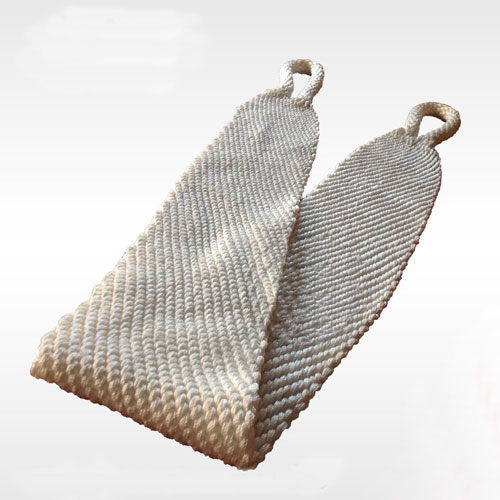
Flat Woven Webbing Sling
China Lifute Sling Group manufactures flat woven webbing slings to EN 1492-1 in 1 t to 12 t standard capacities — and to 100 t on request — from high-tenacity polyester (PES) webbing, colour-coded to the standard, batch-tested on a 100-ton horizontal tensile testing machine, and supplied with a traceable label and test certificate.
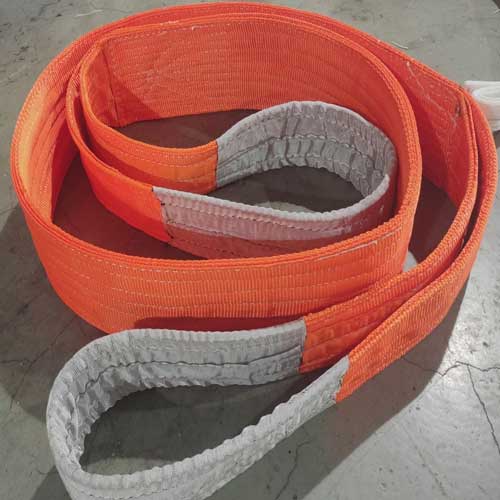
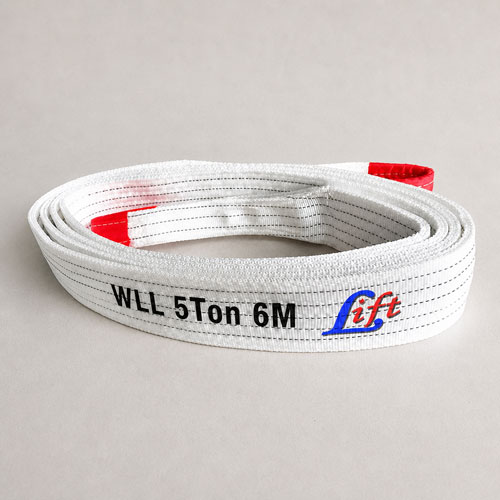
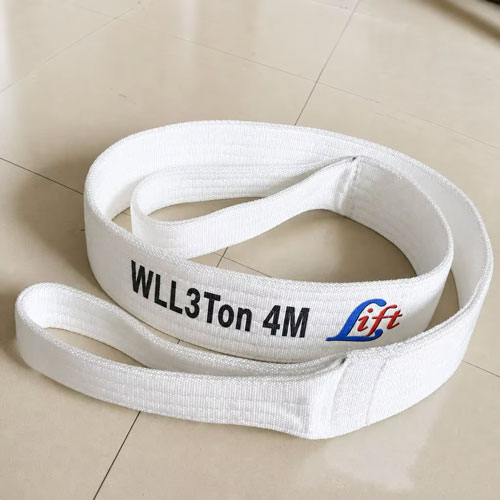
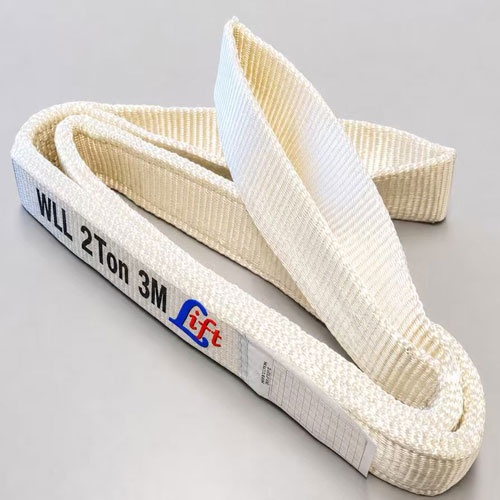
Flat woven webbing slings are the general-purpose lifting sling of modern industry: soft enough to protect a machined surface, light enough for one person to carry, and strong enough to lift steel plate, precast concrete, glass, pipe and plant on a daily basis. They are sewn from flat woven man-made webbing into either an eye-and-eye or an endless (ring) form, and are used in vertical, choker and basket hitches.
Need a quote? Tell us the working load limit, the standard, the length, the hitch and the working environment — we will come back with a task-specific offer rather than a catalogue page.
Why engineers specify flat woven webbing slings
No metal contact. Unlike chain or wire rope, the webbing touches the load directly — no shackles or hooks against a finished surface, so no marring, no galvanic contact, no spark risk.
Wide bearing surface. The flat section spreads load over a large area, giving far lower surface pressure on the load. This is why webbing slings are routine for glass, polished plate, coated pipe and precast panels.
Light and manageable. A 5 t webbing sling can be carried and positioned by hand. The equivalent chain sling needs two people and a pallet truck.
Low elongation under load. Polyester webbing extends only slightly at WLL, which keeps a lift predictable and controlled instead of springy.
Colour-coded to standard. The capacity is visible at a glance, anywhere on site, without reading a label in poor light.
Reversible wear. In an endless form the sling can be rotated so that wear is shared around the whole loop, extending service life.
Colour code and working load limit
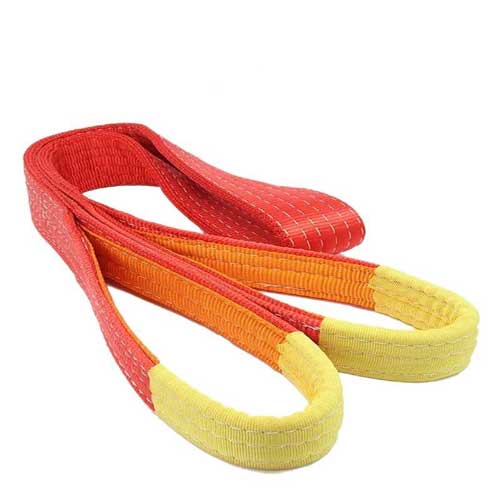
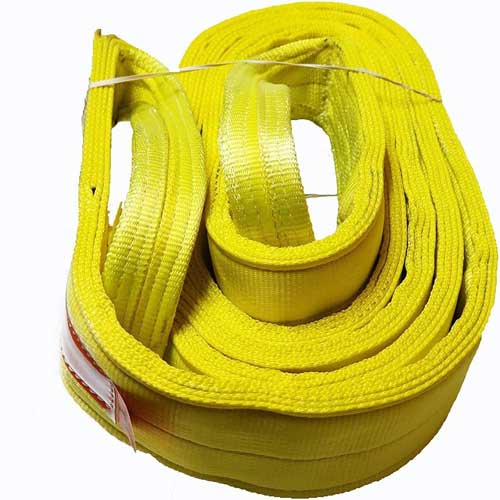
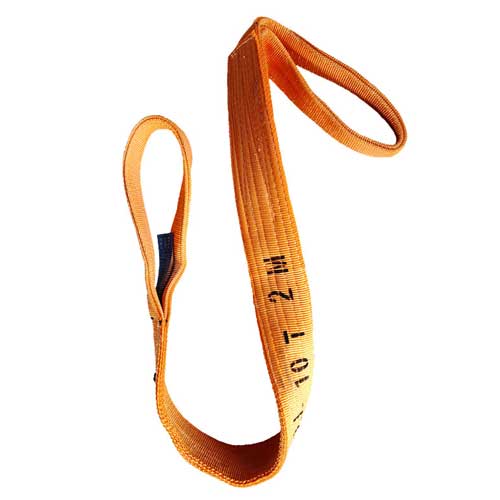
Under EN 1492-1 the webbing colour identifies the WLL for a straight lift, and the number of black transverse stripes repeats the tonnage. Capacity in other hitches is read from the label.
| Webbing colour | Black stripes | Typical width | WLL, straight lift |
|---|---|---|---|
| Violet | 1 | 30 / 50 mm | 1 t |
| Green | 2 | 60 mm | 2 t |
| Yellow | 3 | 90 mm | 3 t |
| Grey | 4 | 120 mm | 4 t |
| Red | 5 | 150 mm | 5 t |
| Brown | 6 | 180 mm | 6 t |
| Blue | 8 | 240 mm | 8 t |
| Orange | 10 | 300 mm | 10 t |
| Orange | 12 | 300 mm | 12 t |
Capacity changes with the hitch — mode factors
The published WLL is a vertical (straight) lift figure. Every other arrangement is calculated by multiplying it by a mode factor.
| Sling arrangement | Mode factor | A 5 t sling gives |
|---|---|---|
| Vertical | 1.0 | 5.0 t |
| Choker | 0.8 | 4.0 t |
| Basket, parts parallel (β = 0°) | 2.0 | 10.0 t |
| Basket, β up to 45° | 1.4 | 7.0 t |
| Basket, β 45–60° | 1.0 | 5.0 t |
| Two-leg, master link angle ≤ 90° | 1.4 | 7.0 t |
| Four-leg, master link angle ≤ 90° | 2.1 | 10.5 t |
Two points worth remembering: factors multiply — a two-leg assembly at 45° that is also choked gives 1.4 × 0.8 = 1.12 — and a four-leg sling is 2.1, not 4.0, because one leg acts largely as a stabiliser in practice.
Materials
Three man-made fibres are covered by EN 1492-1. The colour of the label — not the colour of the webbing — tells you which one you have.
| Fibre | Label colour | Temperature range | Chemical resistance |
|---|---|---|---|
| Polyester (PES) | Blue | −40 °C to +100 °C | Resists most mineral acids. Attacked by alkalis. |
| Polyamide (PA / nylon) | Green | −40 °C to +100 °C | Immune to alkalis. Attacked by acids. |
| Polypropylene (PP) | Brown | −40 °C to +80 °C | Unaffected by acids or alkalis. Attacked by solvents. |
Polyester is our standard production fibre: high tenacity, low elongation, good UV and abrasion performance. Polyamide and polypropylene are available where the chemical environment or the temperature duty calls for them. Special constructions are available for high-temperature service and for acid-resistant duty — tell us the exposure and we will specify the fibre rather than guess at it.
Construction options
| Feature | Options |
|---|---|
| Form | Eye-and-eye (two sewn eyes) · Endless / ring (continuous loop, no end fittings) |
| Plies | Simplex (1) · Duplex (2) · Triplex (3) · Quadraplex (4) |
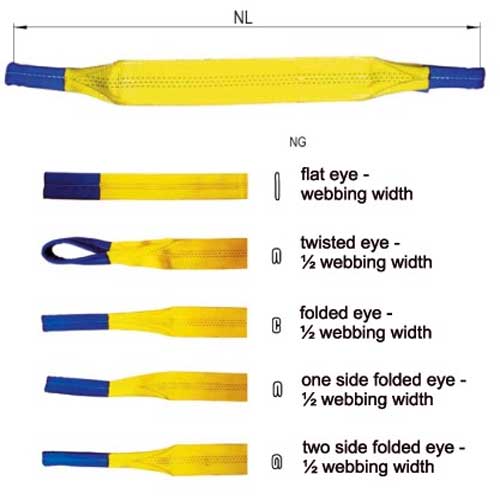
| Eye type | Flat eye · Twisted eye · Reversed eye · Reinforced (protected) eye |
| Protection | Wear sleeves and reinforced eyes for hook and edge contact |
| Duty | General purpose · One-trip / disposable · Heavy tonnage · High-temperature · Acid-resistant · Glass handling |
How length is measured: from bearing point to bearing point, with the sling laid flat. Please state the length on this basis, and confirm whether you are specifying the length of the sling or the circumference of a ring sling — the two are not the same number.
Standards and conformity
| Standard | Region | Safety factor |
|---|---|---|
| EN 1492-1 | Europe, UK, Middle East, Africa | 7:1 |
| ASME B30.9 | USA, Canada | Commonly 5:1 |
| AS 1353 | Australia, Oceania | Commonly 8:1 |
| JIS B 8818 | Japan | As specified |
We manufacture to EN 1492-1 with a 7:1 safety factor as standard, and to the other standards on request — please name the standard and the safety factor explicitly on the purchase order. Webbing built to a 5:1 or 8:1 standard is not interchangeable with EN 1492-1 webbing of the same marked capacity, because both the safety factor and the marking rules differ.
Marking and traceability
Every sling carries a permanently attached, legible label showing at least:
working load limit for a straight lift;
the material of the webbing;
the standard reference;
length, sling type and manufacturer;
a traceability code linking the sling to its production batch and test record.
The label is the document that certifies the sling. A sling with a missing or illegible label is out of service, whatever its colour.
Where flat woven webbing slings are used
Iron and steel · shipbuilding and shipyards · ports and terminals · power generation and energy · glass and stone · precast and prestressed concrete · pipe and tube handling · wind turbine components · heavy machinery and plant installation · general fabrication and logistics.
Safe use and inspection
Always
Inspect the sling before every use, and again before returning it to store.
Position the sling so the load is spread evenly across its full width.
Use protective sleeves or packing wherever the webbing meets a sharp edge.
Set the choke lift at its natural angle, about 120°.
Apply the correct mode factor for the arrangement, and confirm it against the label.
Never
Shorten, knot or tie a webbing sling.
Expose it to direct heat, flame or welding spatter.
Shock load it.
Use it if the label is missing or illegible.
Use it if the webbing is cut or the stitching is loose.
Withdraw from service
On any of the following: illegible or missing markings; chafed, cut or damaged webbing; loose or damaged stitching; heat burns, chemical damage or UV degradation; damaged or deformed end fittings.
Storage
Clean with clear water and dry naturally before storage. Never return a wet or contaminated sling to the rack. Store hung on non-rusting pegs, dry, out of direct sunlight and away from heat sources.
Ordering information
To quote accurately we need eight things. Send them and we will come back with a task-specific offer.
Working load limit required
Standard and safety factor (for example EN 1492-1, 7:1)
Length, and how it is measured
Required hitch type(s) — vertical, choker, basket
Fibre: polyester, polyamide or polypropylene
Working environment: temperature, chemicals, sharp edges, UV exposure
Quantity
Any marking, labelling or traceability requirement, plus OEM branding if required
Frequently asked questions
What is the difference between a flat woven webbing sling and an endless webbing sling?
Both are made from flat woven webbing. An eye-and-eye sling has two sewn eyes and is used as a two-ended sling. An endless (ring) sling is closed into a continuous loop with no end fittings, so it can be rotated to share wear and used in any orientation.
What is the WLL of a flat woven webbing sling in a choker hitch?
A choker hitch applies a mode factor of 0.8, so capacity is 80% of the vertical WLL. A 5 t sling gives 4.0 t choked.
How much can a webbing sling lift in a basket hitch?
With the two parts parallel and the load balanced, the mode factor is 2.0 — twice the vertical WLL. At 45° the factor falls to 1.4, and at 60° to 1.0, so the gain disappears quickly as the legs spread.
Does a four-leg sling lift four times the load?
No. Because legs differ slightly in length and loads are rarely perfectly level, one leg acts largely as a stabiliser. The mode factor for a four-leg arrangement at a master link angle of 90° or less is 2.1, not 4.0.
Does the colour of the webbing tell me the material?
No. The webbing colour codes the WLL band. Material is shown by the colour of the label: blue for polyester, green for polyamide (nylon), brown for polypropylene.
What safety factor do your webbing slings have?
7:1 to EN 1492-1 as standard — the minimum breaking load is at least seven times the marked WLL. Other safety factors are available against the corresponding standard.
About China Lifute Sling Group
China Lifute Sling Group manufactures webbing slings, endless slings, round slings and rigging from its base at the TaiZhou Lift Sling Net Belt Factory, Gaogang District, TaiZhou, Jiangsu Province. The works has been in sling production since 1980 and has been a registered manufacturer since 2002.
Weaving, stitching and finished-product assembly are carried out in-house across more than 10,000 m² of workshops, with 86 production staff.
In-house verification includes a fibre testing instrument, a rope-and-belt tensile testing machine and a 100-ton horizontal tensile testing machine — the basis for breaking-load verification and batch records.
ISO 9001 quality management certification and 15 patents.
Products supplied to markets including Korea, Japan and Saudi Arabia.
Send us your eight ordering points and we will quote to your standard, test to your standard and document to your standard.