语言选择: 


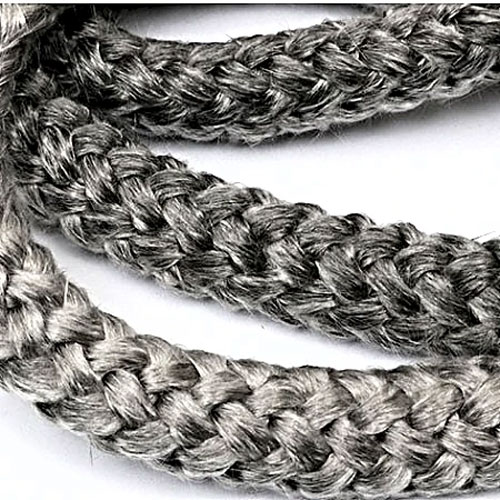
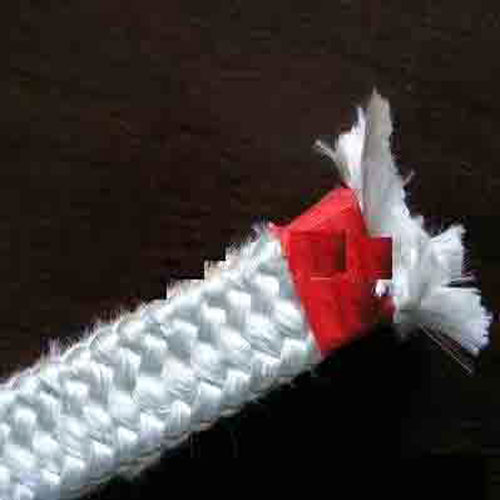
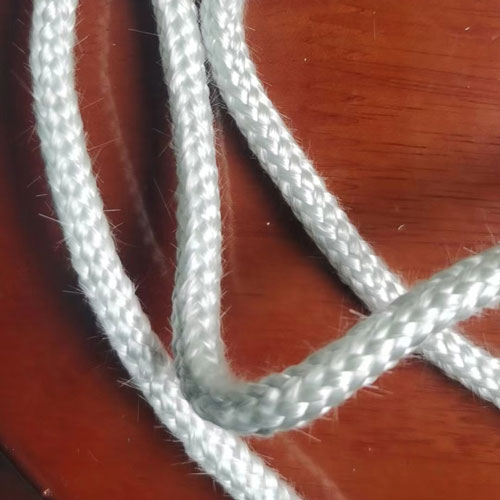
China Lifute Sling Group manuafcture Fiberglass Furnace Door Sealing rope,Fiberglass Boiler Rope,Fiberglass Door Rope,High Temperature Fiberglass Sealing Rope for Fireplace, Boiler, Oven,Square Glass Fibre Packing Rope for Sealing Doors.
Fiberglass Furnace Door Sealing Rope is the compressible cord that sits in the door groove of a fireplace, boiler or oven and closes the joint when the door lands on it. It is braided from E-glass filament — asbestos-free — rated 540 °C continuous, and soft enough to be pressed into a channel by hand. What matters when you buy is which build goes into which door, and how the rope is inserted so the joint seals on the first firing.
A fireplace door, a boiler door and an oven door are all listed as door sealing rope, and in service they are not the same component. What closes the door, how often it cycles, and how flat the face stays decide the section, the braid density and the finish.
| Door | What closes it | Section | Braid | Finish |
|---|---|---|---|---|
| Fireplace / wood stove | Hand latch or cam handle | 6–12 mm round | 8–12 carrier, slack lay | Graphite impregnated |
| Boiler, vessel, dryer | Bolts or swing clamps | 10–20 mm round or square | 16 carrier, firm | Uncoated or graphite |
| Oven / furnace | Hinge plus thermal growth | 12–25 mm; silica above 540 °C | 12–16 carrier | Uncoated |
On a stove or fireplace the handle has to reach its catch, so the rope cannot be thick and hard. A soft 8–12 carrier braid, compressed about a quarter of its diameter, is what the door was designed around; overfill the groove and the latch strains, the glass loads up, and the door still smokes. A graphite finish keeps the braid from sticking to the door face after a hot season.
A boiler, dryer or vessel door is clamped down, and a slightly overfilled section is the right choice — it takes up casting distortion that a nominal-size rope would leave as a leak path. Use a firm 16-carrier braid and confirm the clamp still reaches its stop with the rope in place. Where the lid is lifted rather than hinged, an optional stainless wire core holds the shape against being yanked.
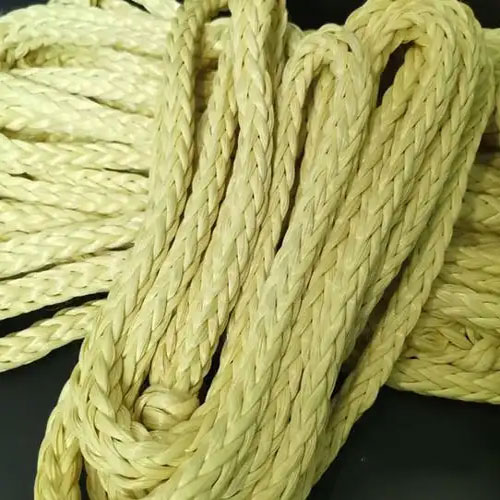
An oven or furnace door heats, bows and returns several times a shift, and the seal has to follow all of it. Standard E-glass to 540 °C covers most ovens, dryers and boiler doors; kiln and furnace doors above that go to silica at 1,000 °C or alumina-silicate at 1,200 °C. If you are changing the same seal at the same interval for the second time, move up a grade before changing anything else. Where the plant needs a radiant barrier instead of a joint, that is a different product — an aramid safety rope net, not a rope.

| Construction | Braided round or square section; 3-strand twisted on request |
|---|---|
| Material | E-glass filament (standard) · silica · alumina-silicate. Asbestos-free |
| Round diameter | 3, 4, 5, 6, 8, 10, 12, 14, 16, 20, 25 mm |
| Square section | 6×6 to 25×25 mm |
| Diameter tolerance | ±0.5 mm up to 10 mm; ±0.8 mm above 10 mm |
| Service temperature | 540 °C continuous / 650 °C short peak (E-glass) Silica 1,000 / 1,200 °C · alumina-silicate 1,200 / 1,260 °C |
| Braid | 8, 12 or 16 carrier; picks per metre set to the groove width |
| Core | Stainless steel wire core, optional |
| Compression in service | 25–30% of the section, door closed |
| Weight, approx. | 6 mm ≈ 55 g/m · 10 mm ≈ 150 g/m · 16 mm ≈ 380 g/m · 20 mm ≈ 600 g/m |
| Supply length | 10 / 20 / 50 m coils, spools, or cut to door size |
| Chemical | Stable in most flue and furnace atmospheres; not for hydrofluoric acid or hot concentrated alkali |
Measure the groove, not the old rope. A cord that has been compressed and fired for years reads 10–15% under the section that has to go back into the same channel.
Cut at rest length, square, and tape before cutting. A rope pulled to make the ends meet is thinner everywhere it was pulled — and that run is where it smokes.
Butt the ends; never overlap. Put the joint at the bottom of the door or in a corner, never at the top where the flame path runs.
Press in without twisting. Run a thumb along the braid as it goes down so the lay stays straight; a twisted rope sits proud on one side and low on the other.
Bed sparingly in high-temperature cement. Enough to hold the rope in a retrofit groove, not a layer sitting between rope and door face.
Cure before firing. About one hour at 100 °C, then one hour at 200 °C. Firing a wet seal steams the cement and lifts the rope out of the channel.
Close the door cold, then open it and look at the rope. A continuous bright line is contact; a break in the line is the leak, and it will still be there after the next firing. A 0.05 mm feeler blade that slides under the rope anywhere means the groove is too deep or the door face is warped — packing in more rope bows the casting instead of closing the gap.
Compression rule of thumb: 25–30% of the diameter with the door shut. Under 20% the joint never closes cold; over 40% the filaments crush, the braid takes a permanent set, and a seal that was tight when new leaks within the first few cycles.
Three dimensions taken with a caliper decide the part: groove width, groove depth, and the gap left when the door is shut. Add the door type and the temperature measured at the rope after a full cycle — not the set point. We come back with diameter, braid, grade and cut length, plus a sample for trial fitting. For general-purpose insulation packing on stove and kiln shells rather than a door joint, the same braid is listed as round braid fiberglass rope; the wider heat-resistant range sits under nylon rope and braided cord.

Need a cut length for a specific door? Request a quotation online or send us the three groove numbers — samples are available before you commit to a coil.
Not in the rubber sense. The filament elongates about 4% and then fails. The rope behaves elastically because it is braided: radial compression opens the braid angle and the angle closes again on release. Picks per metre and carrier count decide how much of the section comes back.
Standard E-glass runs 540 °C continuously with short peaks to about 650 °C; silica goes to 1,000 °C and alumina-silicate to 1,200 °C. Judge it at the rope, not at the flue or the controller: on a wood stove the seal usually runs 100–200 °C below the flue, on a kiln door it can run hotter than the chamber reading.
Round for a round groove or a channel with a flat lip, and a hinge parallel to the frame. Square for a rectangular groove, a flat cast door, or a hinge that lets the door twist as it closes.
No on a machined groove — compression holds it. Yes on a retrofit or a vessel mouth where the rope has to stay put while the lid is offered up. Keep the cement thin either way.
Company:China Lifute Sling Group
Contact:Mss Wang
Tel:+8613365203036
Mobile:+8613365203036
E-mail:cnlift@126.com
Address:TaiZhou City, JiangSu Province, Lifute District ,China